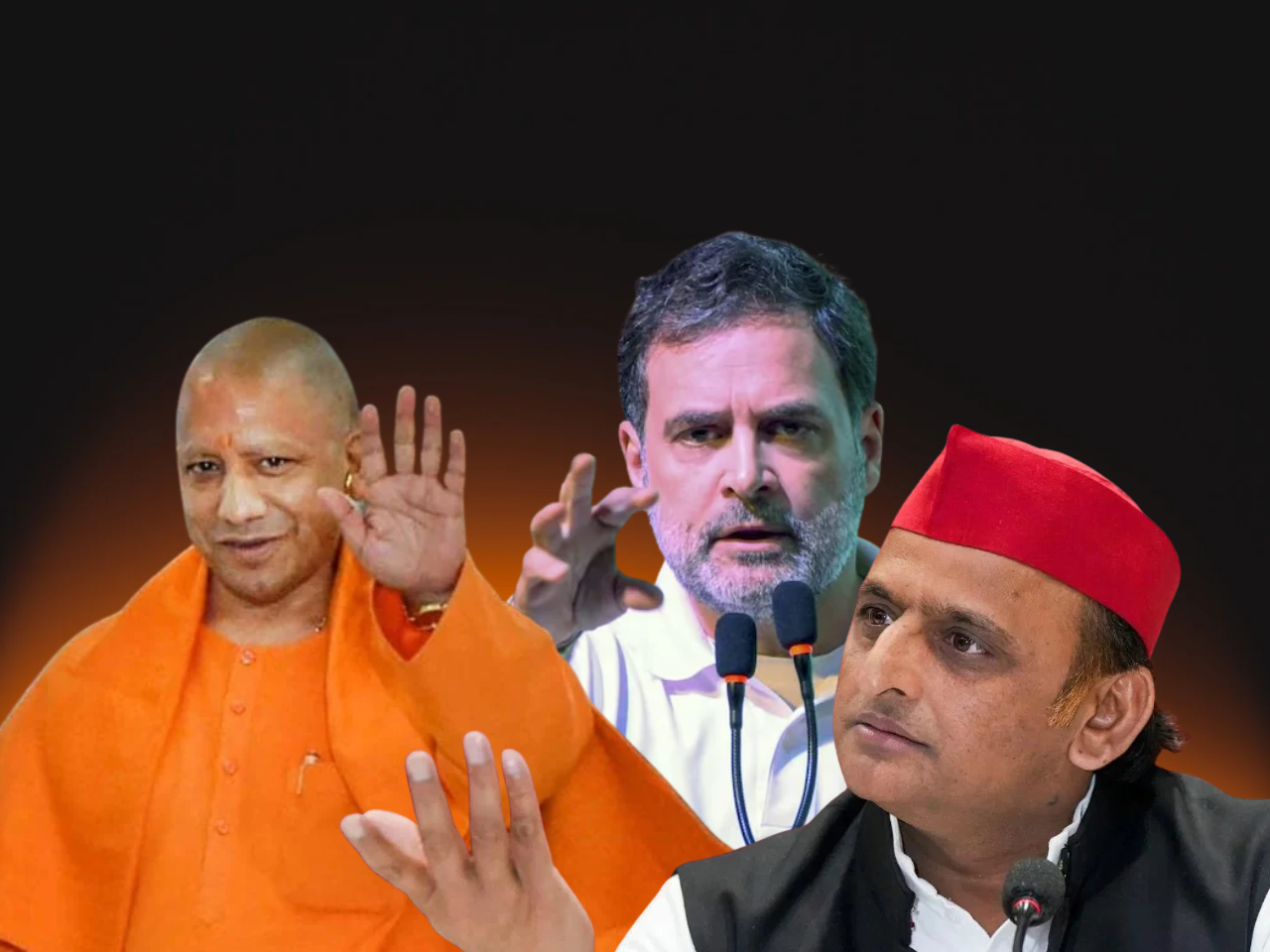

SCORE’s first opinion poll puts the NDA and the Samajwadi Party-led opposition within striking distance in Uttar Pradesh. Behind the narrow numbers lies a shifting electoral map, a widening gender divide in voter preference and a contest increasingly shaped by regional politics.
Uttar Pradesh may be heading towards an election in which neither of the two principal political forces can afford to take its traditional electoral strengths for granted.
A new opinion poll by SCORE Intelligence, surveying 91,429 voters across all 403 Assembly constituencies, places the BJP and the Samajwadi Party almost level in vote share, while leaving the broader alliance contest within a narrow margin. The survey, conducted between September 16 and November 20, 2026, projects 42 constituencies as too close to call.
The numbers are striking. The BJP’s projected vote share is 36.7%, against 37% for the Samajwadi Party. At the alliance level, the NDA is projected to have a narrow advantage over the INDIA alliance, but the seat ranges overlap substantially.
This is not a poll that offers a straightforward prediction of who will govern Uttar Pradesh. It offers something more revealing: a picture of a state where the BJP’s electoral dominance appears to have weakened, the Samajwadi Party has gained ground, and the outcome could depend on how effectively both sides consolidate voters across sharply different regions and social groups.
The findings, released by SCORE on November 25, are a snapshot of voter sentiment, not an election forecast. But the shifts reported since 2022 deserve attention.
The numbers suggest a political reset since 2022
The biggest change in SCORE’s findings is the movement in the vote shares of the BJP and the Samajwadi Party.
The BJP’s vote share is estimated at 36.7%, down from 41.3% in the 2022 Assembly election. The Samajwadi Party, meanwhile, is placed at 37%, up from 32.1%.
according to SCORE, these figures represent a 4.6-percentage-point decline for the BJP and a 4.9-percentage-point increase for the SP.
The movement suggests a more competitive electoral landscape than the BJP’s 2022 performance would ordinarily imply. But vote share alone does not determine who wins a state election, particularly in Uttar Pradesh, where constituency-level contests, alliance arrangements, candidate selection and local social coalitions can produce very different outcomes from statewide numbers.
SCORE’s constituency-based projection puts the BJP at 177–215 seats on its own and the SP at 160–202 seats. These are ranges, rather than fixed predictions, and include constituencies classified as too close to call.
The alliance arithmetic is similarly tight. By adding the projected votes of the SP and Congress on constituencies, SCORE estimates the INDIA alliance at 174–219 seats, compared with 181–226 for the NDA.
The poll therefore does not establish a clear winner. It points to a contest in which the two principal alliances could be separated by relatively few seats.
The BJP’s advantage is not uniform across Uttar Pradesh
The statewide picture hides some of the most interesting political developments in the survey.
SCORE’s regional breakdown suggests that Uttar Pradesh is behaving less like a single electoral market and more like a collection of contests with different political dynamics.
In West UP, which has 136 Assembly seats, the BJP’s vote share is estimated to have fallen from 45.4% in 2022 to 38.1%. Despite the decline, the NDA is projected to lead in the region with 84–90 seats.
Purvanchal, with 141 seats, presents a different picture. The SP is estimated to have 38.6% of the vote, against 31.6% for the BJP, a seven-percentage-point gap. This makes eastern Uttar Pradesh a significant battleground in the poll.
Awadh, comprising 107 seats, is almost evenly divided. SCORE puts the BJP at 40.3% and the SP at 39.4%.
Bundelkhand, with 19 seats, is the only region where the BJP’s vote share is reported to have increased since 2022, reaching 41.1%.
The poll’s regional estimates suggest that a statewide swing, if one exists, is not translating uniformly across the state. The BJP retains an advantage in parts of western Uttar Pradesh and Bundelkhand, while the SP’s position is stronger in Purvanchal. Awadh remains closely contested.
For political strategists, this complicates the campaign calculus. A statewide message may not be enough. The parties could need different electoral strategies for regions where their voter coalitions are holding, weakening or expanding.
Forty-two constituencies could become the election’s decisive battleground
SCORE has classified 42 Assembly constituencies as too close to call. Thirty-eight of these are direct contests between the BJP and the SP, while 15 are located in Awadh.
The poll says the NDA leads outright in 196 constituencies, six short of the 202-seat majority mark in the 403-member Assembly. The SP leads in 160, leaving the 42 tied constituencies unresolved in the survey’s current classification.
These seats could prove decisive in an election where the projected alliance ranges overlap.
But the importance of the tied seats goes beyond the arithmetic. A closely contested constituency is often where local candidates, turnout, community mobilisation and campaign issues can have an outsized impact.
The presence of 42 seats classified as ties also illustrates the limits of interpreting a poll as a prediction. SCORE’s seat ranges are built around constituency-level estimates, and the report does not provide, in the press release, a detailed explanation of how uncertainty within each constituency is quantified.
The poll’s large sample is noteworthy, but sample size alone does not eliminate survey error. The sampling design, weighting, respondent selection and constituency-level uncertainty are important to understanding how much confidence should be placed in the projections.
Women voters emerge as a significant BJP advantage
One of the most striking findings in the report is the gender divide in voting preference.
Among women respondents, 46.2% reportedly backed the NDA, compared with 31.5% for the SP. Among men, the preference reverses: 41.9% support the SP and 35.1% the NDA.
The contrast suggests that women voters could be an important electoral advantage for the BJP-led alliance, if the survey’s findings hold in the election.
SCORE founder Naresh Arora argues that the BJP’s position among women, alongside Yogi Adityanath’s popularity and perceptions of law and order, could strengthen the party’s prospects. He also refers to the possibility of a reported women’s cash-transfer scheme further influencing voter preference.
That last point remains conditional. The poll’s finding on women voters is distinct from any potential effect of a future policy announcement or scheme. The impact of a cash transfer would depend on its design, credibility, implementation and the way voters assess it.
The gender gap, however, is already significant in the survey. It suggests that the electoral choices of women and men may be shaped by different political priorities, perceptions or assessments of the parties.
For the opposition, the challenge may not simply be to improve its overall vote share, but to understand why its support among women appears considerably weaker in this survey.
Caste loyalties remain, but local politics complicates the picture
Uttar Pradesh’s electoral politics continues to be shaped by caste, but SCORE’s findings suggest that political preferences within caste groups may not be uniform across constituencies.
Yadav voters remain strongly aligned with the SP, with 70.4% reported support. Jatavs are most strongly aligned with the BSP, which receives 43.3% support among the group.
The NDA leads among most other Hindu caste groups, according to the report. SCORE also notes that members of the same caste may vote differently across divisions, depending partly on the alignment of local leaders.
This is particularly relevant to non-Yadav OBC voters, a constituency that has played a consequential role in Uttar Pradesh’s electoral outcomes. SCORE says it has published constituency-level preferences for non-Yadav OBC voters on its website.
The broader implication is that caste-based political analysis cannot be reduced to statewide bloc calculations alone. Local leadership, candidate credibility, alliances and constituency-level dynamics may influence how communities vote.
The BSP’s position is also worth watching. SCORE estimates its vote share at 11.4%, with one projected seat. The Congress is placed at 7.7%, with two seats, while the Jansatta Dal (Loktantrik) is also projected to win two.
These figures suggest that smaller parties may have limited seat prospects in the poll, but their vote share could still matter in constituencies where the principal contenders are closely matched.
Yogi leads the Chief Minister preference question, but the margin is not overwhelming
SCORE’s Chief Minister preference question places Yogi Adityanath ahead of Akhilesh Yadav.
Yogi is named by 35.3% of respondents as their preferred next Chief Minister, compared with 26.5% for Akhilesh Yadav and 8.6% for Mayawati. A further 22.7% are undecided.
The finding gives Yogi a clear lead in the preference question, but the undecided share is substantial and could matter as the campaign develops.
The report also presents personal ratings for the two principal leaders. Yogi Adityanath scores 69.6 out of 100, while Akhilesh Yadav scores 68.3.
The near-equal personal ratings alongside the difference in Chief Minister preference and party voting estimates are particularly interesting. They suggest that voters may evaluate a leader differently from the party or political formation he represents.
SCORE founder Naresh Arora argues that Akhilesh’s personal rating does not translate proportionately into Chief Minister preference, attributing this in part to perceptions of law and order associated with the SP.
That is the poll’s interpretation, rather than an independently established explanation for the difference. Nevertheless, the distinction between leader approval, party preference and the choice of a Chief Minister is politically significant.
The survey suggests that the contest is not simply a referendum on the popularity of two leaders. It may also reflect how voters assess parties, their past governance, local candidates and the alliances they represent.
Uttar Pradesh’s next election may be decided by the ground between the numbers
The SCORE poll offers a picture of a more competitive Uttar Pradesh than the BJP’s 2022 Assembly victory might suggest. The SP’s projected vote-share gains, the regional divide, the 42 tied constituencies and the gender gap in voting preference all point towards an election where the outcome may be more sensitive to local dynamics than statewide narratives suggest.
But it would be premature to read the survey as a verdict on the next election.
The poll is a first-round snapshot, conducted over a defined period and based on SCORE’s constituency-level estimates. The report’s large sample makes it an important data point, but the methodology needed to independently assess its precision is not fully laid out in the press release.
What it does offer is a useful political map of the questions both sides may need to answer.
For the BJP, the challenge is to defend its position where its vote share has declined while preserving the advantages the poll identifies among women and in regions where the NDA remains ahead.
For the SP, the challenge is to convert its reported vote-share gains into constituency victories, broaden its support across regions and communities, and translate its leader’s personal ratings into a stronger electoral coalition.
The 42 seats SCORE has left unresolved may ultimately be the most revealing part of the survey. In a state where the difference between a majority and a minority government can be decided by a handful of constituencies, the election may not be about who leads the statewide narrative.
It may be about who wins the contests where that narrative is still undecided.
Disclaimer: This article is based on findings published by the cited polling organisation. The survey data, projections and interpretations have not been independently verified by TICE unless explicitly stated. Opinion polls reflect voter sentiment at the time of the survey and are not predictions or guarantees of election outcomes. Actual results may differ.