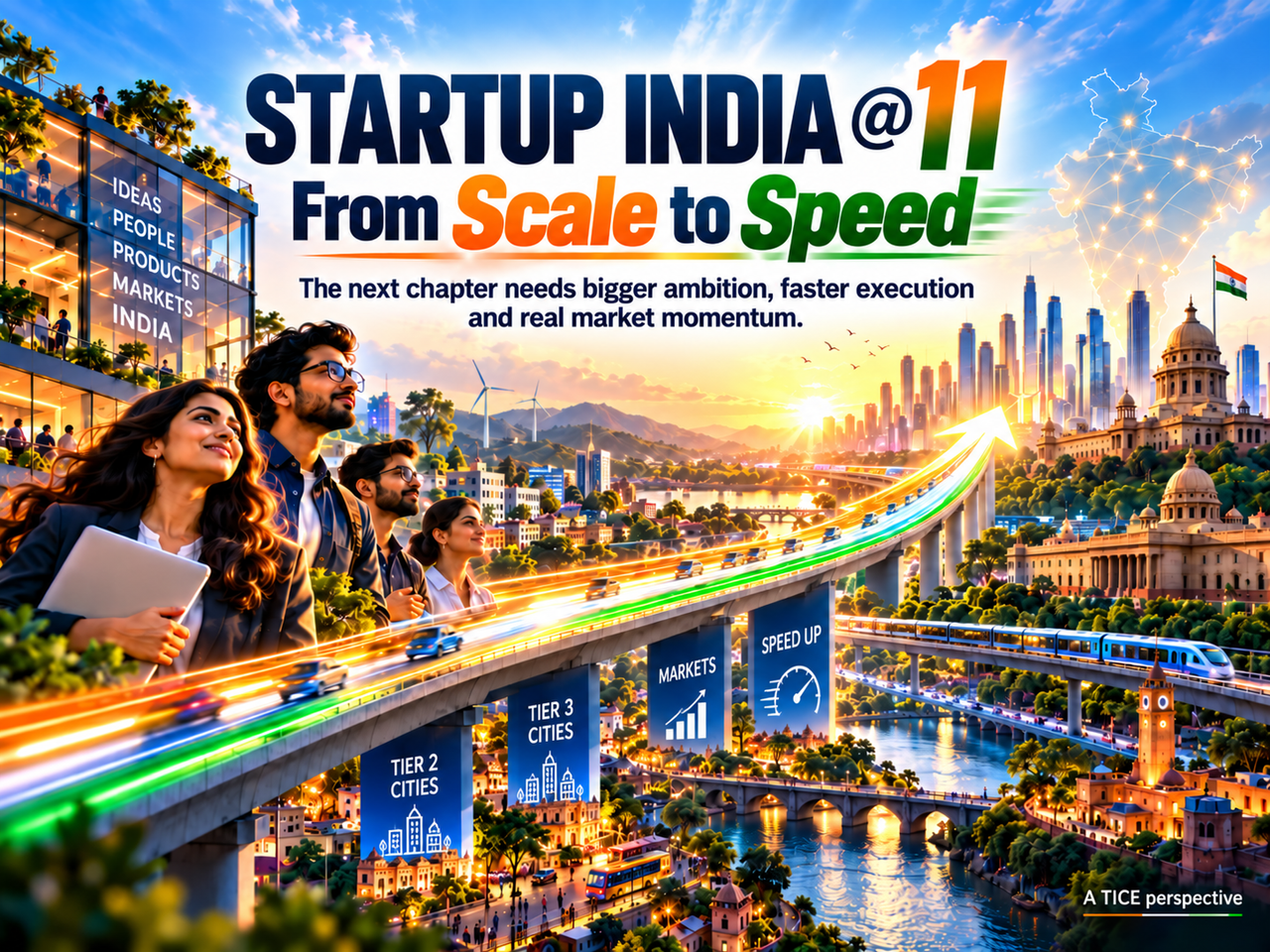

PACE is TICE’s new ecosystem IP connecting investible startups beyond the metros to capital and capital-backed startups to Government markets.
India’s startup ecosystem has entered a new phase. After a decade of Startup India, the question is no longer whether India can create startups at scale. That has been established. The next challenge is velocity.
From Scale Up to Speed Up. If the first 10 years of Startup India is defined by Start up to Scale Up, For this 11th year the mission is from Scale up to Speed up and building a roadmap for the same. So we ask ourseleves a question
How to bringing momentum in Startup Bharat ? What are the gaps in Indian Startup ecosystem and how do we solve them. How do we reduce the friction that still prevents promising startups from reaching the right investors, and funded startups from reaching large institutional markets such as Government?
That is the thinking behind PACE (Procurement Access & Capital Enablement), a new ecosystem IP conceptualised by TICE.

Two Gaps. One PACE.
PACE addresses two connected gaps in the startup ecosystem.
The first is on the capital side.
High-potential startups are increasingly emerging from Tier-II and Tier-III cities. Yet many institutional investors and AIFs operate with lean teams and limited bandwidth to continuously source, screen and evaluate startups across dozens of regional ecosystems.
For founders outside the major startup centres, the opposite challenge exists: building a strong company does not automatically provide access to the right investors.
PACE proposes to bridge this through a structured 25-city Investible Startup Discovery and Capital Access Programme.
The objective is simple:
Discover → Screen → Prepare → Curate → Investor Connect
Rather than treating this as another roadshow, PACE seeks to create a sustained pipeline of investible startups for FoF-backed AIFs, venture capital funds and other institutional investors.
This becomes particularly relevant in the context of Startup India Fund of Funds 2.0, which has a ₹10,000 crore corpus and deploys capital through eligible SEBI-registered AIFs. The FoF 2.0 operational framework also recognises the need to deepen startup support beyond metro regions.
In that sense: FoF 2.0 provides the capital architecture. PACE can strengthen the discovery architecture around it.
From Capital to Government Markets. The second gap begins after a startup raises capital.
Funding is important, but capital must eventually translate into customers, revenue and scale.
For many startups, Government can become a major market. But Government procurement requires a different kind of readiness. Founders need to understand procurement processes, GeM, tenders, PSU opportunities, qualification requirements, documentation, buyer mapping and the path from a successful PoC to commercial procurement.
PACE proposes a second pathway:
Assess → Prepare → Map Buyers → Connect → Procurement Opportunity → Scale
The role of PACE is not to guarantee Government orders or influence procurement decisions. It is to make startups Government-market-ready and help relevant solutions become more discoverable to Government buyers.
Building on Startup India and GeM
TICE already has an MoU with Startup India/DPIIT, creating an institutional foundation for startup engagement, ecosystem mobilisation and founder outreach. TICE also has an MoU with Government e-Marketplace GeM, providing an important link to India’s public procurement ecosystem.
PACE is envisioned as a TICE IP that can work alongside these institutional relationships.
Startup India has helped create and strengthen the ecosystem. FoF has helped catalyse capital. GeM has demonstrated that startups can participate meaningfully in public procurement.
PACE asks the next question: Can these connections happen faster, deeper and across more of India?
Importantly, PACE is broader than GeM alone. Government markets also include Ministries, PSUs, States, public & even private institutions and other legitimate procurement pathways.
Why the 11th Year Matters
The first decade of Startup India was largely about building the ecosystem. The second decade can increasingly focus on conversion.
- Converting startup potential into investible businesses.
- Converting investment into scale.
- Converting innovation into customers.
- Converting pilots into procurement.
- And converting entrepreneurial growth beyond the metros into meaningful economic opportunity.
PACE is designed around that transition.
Giving Momentum to the Ecosystem. PACE stands for: Procurement Access & Capital Enablement
Its proposition is straightforward.
- For investors: discover stronger startup pipelines beyond the metros.
- For emerging startups: gain better access to institutional capital.
- For funded startups: become Government-market and procurement-ready.
- For Government: improve access to credible, scalable startup solutions.
PACE is ultimately about reducing friction and giving momentum on both sides in Startup Bharat ecosystem and Giving momentum to India’s startup ecosystem in its 11th year.For more details and register your interest Join the 1st Cohort of PACE https://gatetice.com/