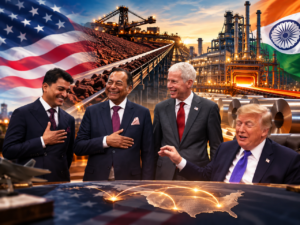

When Donald Trump stood with the Ruia family to announce an $18 billion steel investment in America, the obvious story was the size of the cheque.
Through Mesabi Metallics, Essar Group plans to invest about $15 billion in a new steel complex in Iowa, on top of roughly $3 billion already invested in its Minnesota iron-ore operation. The Iowa plant is planned to produce 7.5 million tonnes of steel a year initially, with capacity eventually rising to 10 million tonnes. Minnesota’s iron-ore operation is expected to supply the raw material, creating an integrated mine-to-mill chain.
But there is a more consequential business story behind the announcement.
The same Ruia family once built Essar Steel into a major industrial business, only to lose it through India’s insolvency process. The group subsequently sold or monetised several large assets and embarked on a massive debt-repayment exercise.
Now it is building steel again.
That makes the $18 billion investment less a story about a comeback and more a story about what management does when a balance sheet breaks but the assets created still have value.
That distinction is worth examining.
/fit-in/580x348/filters:format(webp)/tice-news-prod/media/media_files/2026/09/29/essar-us-steel-investment-2026-09-29-20-30-58.png)
When Financial Control Breaks, Asset Value Can Survive
Essar’s expansion came during India’s high-growth years, when large industrial projects could be financed with substantial amounts of debt. The group built businesses across steel, oil, power, ports and infrastructure.
The model worked while growth was strong.
Then the environment changed.
Debt has an unforgiving characteristic in capital-intensive businesses: interest does not stop because a project is delayed. Repayments do not disappear when commodity prices weaken. A regulatory setback does not reduce the principal.
That creates a difficult paradox. A business can lose financial control without necessarily losing its underlying economic value.
Essar Steel became one of the defining cases of India’s new insolvency regime. ArcelorMittal’s first formal bid in February 2018 was reported at around ₹32,000 crore. Numetal subsequently raised its offer to ₹37,000 crore, while ArcelorMittal later revised its proposal to ₹42,000 crore and eventually emerged as the preferred bidder.
The Ruias saw the business differently.
In October 2018, Essar Steel’s shareholders proposed a ₹54,389-crore settlement under Section 12A of the Insolvency and Bankruptcy Code, including ₹47,507 crore in upfront cash and ₹45,559 crore for senior secured financial creditors. The proposal sought to settle claims and withdraw the company from insolvency. It was not accepted.
The significance is not that the promoters’ valuation ultimately prevailed. It did not.
The more important point is that the dispute demonstrated the difference between an asset becoming financially distressed and an asset becoming economically worthless.
Essar Steel eventually went to ArcelorMittal, with its resolution plan providing about ₹42,000 crore to financial creditors.
The promoters lost control. The industrial asset, however, retained substantial value.
The Hardest Management Decision Was to Sell
This is where the Essar story becomes more interesting as a management case.
When the balance sheet came under severe pressure, the group had to do something that is particularly difficult for entrepreneurs who have spent years building industrial businesses:
It had to sell.
Essar Oil was sold to a consortium led by Rosneft and Trafigura/UCP. Essar Steel went to ArcelorMittal and Nippon Steel. Other businesses and assets were also monetised.
The important question is not simply why those assets changed hands.
It is why they could be sold for substantial amounts in the first place.
The group had built large industrial assets with real operating value. When those assets came to market, strategic buyers were willing to pay for them. The proceeds provided a route to repay lenders.
According to Essar’s own account, the group ultimately repaid about $25 billion of debt. Reuters reported in 2022 that Essar had completed its deleveraging programme and become debt-free after repaying that amount to banks and financial institutions.
That is more than a balance-sheet statistic.
If the underlying assets had been poor, there would have been little to monetise. Instead, those assets created the financial capacity to rebuild.
That may be one of the least discussed parts of the Essar story: the group had created enough underlying value to give the balance sheet a way back.
/fit-in/580x348/filters:format(webp)/tice-news-prod/media/media_files/2026/09/29/rewant-ruia-chairman-mesabi-metallics-2026-09-29-20-38-21.png)
Knowing When Not to Own What You Built
There is a management problem that rarely appears in financial statements: entrepreneurs become emotionally attached to what they build.
A refinery is not just a refinery if you spent a decade building it. A steel plant is not simply steelmaking capacity when it represents a family’s industrial ambition.
But when the financial structure becomes unsustainable, sentiment can become expensive.
Essar’s eventual response was pragmatic: assets were monetised, lenders were repaid and the group became smaller.
The lesson is subtle.
An entrepreneur does not have to believe an asset is bad to decide to sell it. The real question is whether selling it now creates more value than continuing to own it under the existing financial circumstances.
That is a very different mindset from defending ownership at all costs.
The Essar Steel episode captures that tension unusually well. The Ruias were prepared to put ₹54,389 crore on the table for a business they believed was worth considerably more than the resolution offer then available. They ultimately lost the asset, but the subsequent process demonstrated that the business had enough value to attract one of the world’s largest steelmakers.
For entrepreneurs, the lesson is uncomfortable but useful:
You can believe deeply in an asset and still accept that you may no longer be the right owner of it.
The Second Steel Business Is Being Built Differently
This is what makes the American project more interesting than a simple return to steel.
Mesabi Metallics is not merely recreating the old Essar Steel model in another country.
The Minnesota operation is being developed around the region’s iron-ore resources. The ore will be processed into pellets and supplied to the planned Iowa steel complex, where direct-reduced iron and electric-arc-furnace technology will be used to produce steel.
In simple terms:
Minnesota mine → pellets → Iowa steelmaking → American customers.
That integrated structure gives the new project greater control over its raw-material chain.
The geography is different. The technology is different. The raw-material base is different. The target market is different.
And the project is being conceived after years of deleveraging, consolidation and rebuilding.
Whether that amounts to institutional learning will ultimately be determined by execution. But the architecture of the new business suggests that the experience of the earlier cycle is part of the context in which this one is being designed.
/fit-in/580x348/filters:format(webp)/tice-news-prod/media/media_files/2026/09/29/essar-us-steel-investment-2026-09-29-20-33-09.webp)
The Real Story Is the Decade Between Two Steel Plants
This is why the most revealing part of Essar’s story is not the $18 billion announcement.
It is the decade between the two steel businesses.
The Ruias built aggressively. The group took on enormous debt. The cycle turned. Major assets were lost or sold. Creditors recovered substantial value. The group undertook a massive deleveraging exercise.
And then it began building again.
There is nothing romantic about that sequence.
The earlier mistakes mattered. Excessive leverage mattered. Losing Essar Steel mattered.
But so did the quality of the assets that had been created, the willingness to monetise them, and the decision to use those proceeds to settle obligations rather than cling to ownership.
That is what makes this more than a steel story.
An entrepreneur’s record is not defined only by what he builds when the cycle is favourable. It is also revealed by what he does when the cycle turns against him.
Essar’s American steel venture now provides the next chapter.
Production is still years away. Construction, financing, technology and market conditions will determine whether the $18 billion plan delivers what its promoters expect.
But the more interesting question has already been framed by history:
When an entrepreneur gets the opportunity to build again, does he simply rebuild what was lost—or does he build with the memory of what went wrong?
The answer will not be found in the size of the investment.
It will be found in how the new steel business is built, financed and managed.
And that is ultimately the more interesting story behind Essar’s $18 billion American bet.