
At FICCI FRAMES 2026, Sir Prithul Kumar gave us what I believe could be a new mantra for building Indian IP. It also describes, almost perfectly, the idea behind the Global South Film Festival.
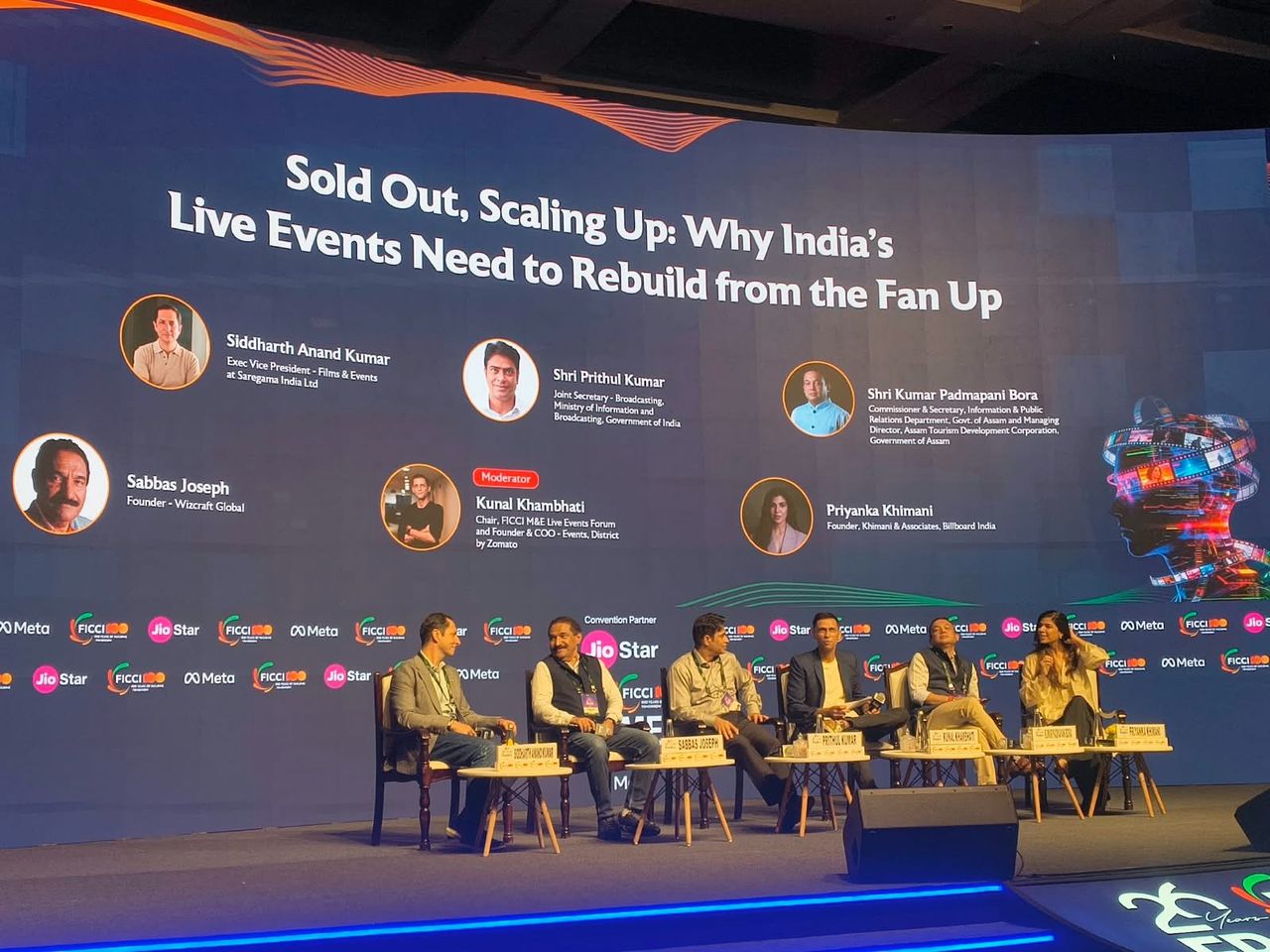
At FICCI FRAMES 2026, during a conversation on the future of India’s live-events industry, Shri Prithul Kumar, Joint Secretary, Ministry of Information & Broadcasting, made two observations that stayed with me.
“We have realised that we cannot survive by just renting the audience of an artist.”
And then:
“Come for a concept. Come for the way you’re treated. I think all of this becomes an IP.”
I think the Ministry of Information & Broadcasting has, perhaps unintentionally, given us a powerful new mantra for thinking about Indian IP.
And it is remarkably close to the philosophy behind the Global South Film Festival.
What if the experience itself is the Intellectual Property?
For a long time, we have tended to think of Intellectual Property in media as a film, character, story, song, television format or franchise.
But an Intellectual Property can also be a concept, a promise and an experience.
Shri Prithul Kumar’s point was made in the context of live events, but it has much wider relevance. If audiences come because they trust the concept, know what experience to expect and feel part of something distinctive, the event begins to own something beyond the artist appearing on stage.
That is the beginning of an Intellectual Property.
The Government is also building an ecosystem around this thinking. The Ministry’s Live Event Development Cell is explicitly tasked not only with professionalising India’s live-event sector and improving infrastructure and permissions, but also with encouraging the creation and promotion of Indian cultural Intellectual Property and positioning India as a global destination for live entertainment.
Come for the concept
That is precisely the question we asked while developing GSFF.
What if people don’t come only for the films? What if they come because they want to experience the Global South?
The Global South Film Festival is an Indian-owned, travelling film and creative-economy platform built around the Global South.
Its core identity is: Cinema + Culture + Capital + Collaboration.
Films are the starting point. Around them are film markets, B2B meetings, co-production opportunities, workshops, masterclasses, AI filmmaking, cultural programming, tourism, local enterprise and international partnerships.
The host city is also part of the experience. But there is another, perhaps more interesting, layer to the idea.
Even “Global South” as a cultural and creative proposition for a travelling film festival remains relatively unexplored.
The term is familiar in geopolitics, economics and international development. But what happens when it becomes a creative community, a space where filmmakers, artists, producers, investors, entrepreneurs and audiences from different parts of Asia, Africa, Latin America and the Middle East meet through stories?
That is the experiment GSFF is attempting. The concept itself becomes part of the IP.
From Ecosystem to Intellectual Property
An idea like this does not emerge in isolation.
India’s institutional ecosystem has been creating more opportunities for international creative exchange. International Film Festival of India (IFFI), organised by National Film Development Corporation (NFDC) under the aegis of Ministry of Information & Broadcasting(MIB) in association with the Government of Goa and the Entertainment Society of Goa (ESG), remains an important part of India’s international film ecosystem.
/fit-in/580x348/filters:format(webp)/tice-news-prod/media/media_files/2026/10/01/gsff-brics-mib-2026-10-01-16-21-57.jpeg)
The BRICS WAVES Bazaar in Mumbai took that conversation further into business and international collaboration. Its 2026 edition brought more than 900 industry delegates from 20 BRICS member and partner countries and facilitated more than 275 curated B2B meetings involving producers, studios, broadcasters, film commissions, investors, technology companies and creative enterprises.
India’s BRICS Chairship also placed culture, creativity and people-to-people connections firmly within the wider cooperation agenda. The New Delhi BRICS Declaration called for stronger international people-to-people exchanges and cooperation, while specifically welcoming the BRICS Film Festival and WAVES Bazaar as platforms for cultural exchange and collaboration.
/fit-in/580x348/filters:format(webp)/tice-news-prod/media/media_files/2026/08/21/gsff-press-2026-08-21-15-52-36.jpeg)
This is important context for GSFF. The institutional environment has helped create the conversations, relationships and confidence from which industry-led initiatives can grow. Infact, we announced the “Global South Film Festival Inaugural Edition in India” at the platform provided to us by NFDC & MIB.
/fit-in/580x348/filters:format(webp)/tice-news-prod/media/media_files/2026/08/21/1786529125681-2026-08-21-16-14-37.jpeg)
GSFF consortium at BRICS WAVES, Mumbai grew to 15+ members from 9 countries. India is intended to be the beginning, not the destination. We are exploring smaller GSFF formats in Kazakhstan, Russia, Thailand, the UAE and Malaysia, alongside annual editions confirmed in South Africa and Brazil for 2028, 2029 respectively
That is how I see GSFF: people-built, industry-led and institutionally enabled.
An Indian IP that can travel
The real test of an IP is whether it can travel without losing its identity.
GSFF is being designed to do exactly that. The first full-scale Indian edition is planned for 3–7 March 2027. The format can change according to the country. The local films, creators, culture and partners can change. The host city can bring its own character.
But the underlying promise remains:
Come for the concept. Come for the experience. Come to connect with the Global South.
That is what makes a travelling IP different from simply taking an event abroad.
People-built. Industry-led.
For me, this is perhaps the most important part of the GSFF story.
The festival is being shaped by filmmakers, producers, entrepreneurs, creative professionals and partners across countries. The institutional ecosystem including MIB, NFDC, IFFI and the wider platforms created around India’s international creative engagement provides an environment in which such ideas can connect and grow.
The next stage is for industry to take ownership of the opportunity.
India should not only export films, artists and content. We should build Indian concepts that the world wants to experience.
GSFF is one such attempt. An Indian-owned Intellectual Property. A Global South proposition. A travelling platform.
And perhaps Sir Prithul Kumar’s words capture the ambition better than anything else:
“Come for a concept. Come for the way you’re treated. I think all of this becomes an Intellectual Property.”
-We want people to come for the films.
-We want them to stay for the experience.
-We want them to connect through the platform.
-And we want them to return because they feel they are part of something.
That is how an event becomes a platform.
That is how a platform becomes an IP.
And perhaps that is how an Indian IP begins to travel.
– Dr Seema Narera
GSFF India Lead