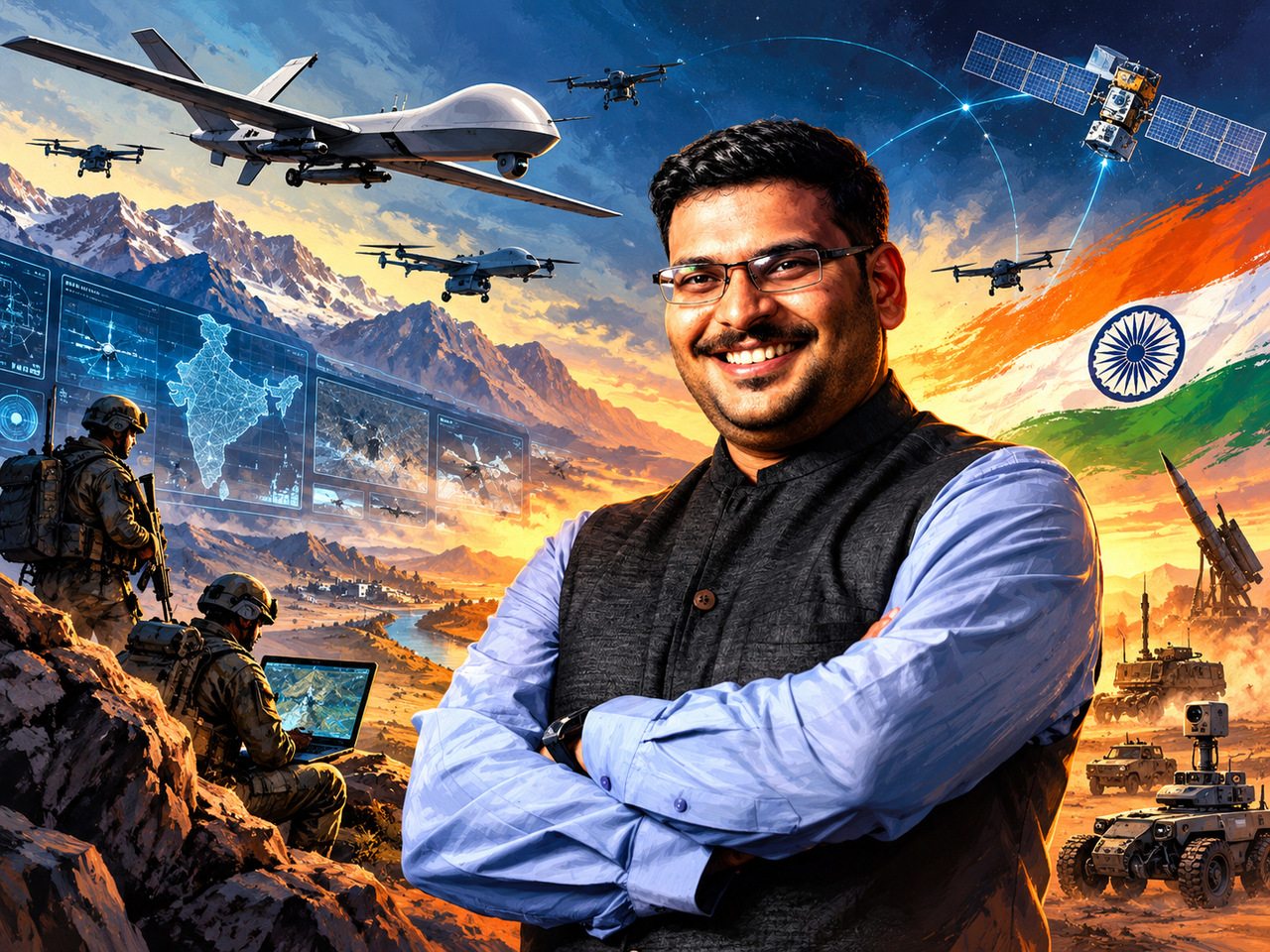

The future of warfare is being shaped by technologies that are changing how conflicts are planned, executed, and managed. Artificial intelligence (AI), autonomous platforms, advanced sensing, and intelligent communication systems are steadily transforming the modern battlefield. By 2035, warfare is likely to be defined not merely by the number of platforms a military possesses, but by how effectively it can connect, coordinate, and deploy them in complex and rapidly changing environments.
For defence forces across the world, preparing for this future requires a fundamental shift in thinking. The focus must move beyond acquiring advanced equipment towards building integrated, intelligent, and adaptable combat ecosystems. For India, this presents both a strategic necessity and an opportunity to strengthen its indigenous defence technology capabilities.
AI Will Become a Core Component of Battlefield Decision-Making
Artificial intelligence is expected to play an increasingly important role in future military operations. Modern battlefields generate enormous volumes of information through drones, satellites, surveillance systems, radars, and other sensors. Processing this information in real time is becoming increasingly difficult for human operators alone.
AI can help analyse this data, identify patterns, detect potential threats, and support faster decision-making. In a complex combat environment, the ability to convert raw information into actionable intelligence could significantly influence operational outcomes.
However, the role of AI should not be viewed simply as replacing human decision-making. Its greater value lies in supporting military personnel by reducing information overload, improving situational awareness, and enabling faster responses.
As we approach 2035, the challenge will be to develop AI systems that are reliable, secure, and capable of functioning under unpredictable battlefield conditions. The effectiveness of these systems will depend not only on their algorithms but also on the quality of their training data, computing infrastructure, and integration with existing defence platforms.
Autonomous Systems and the Rise of Collaborative Warfare
Autonomy will be another defining feature of the future combat environment. Unmanned aerial vehicles, ground robots, and maritime autonomous platforms are already expanding the range of military operations. Over the next decade, these systems are likely to become more capable of navigating complex environments, performing assigned missions, and coordinating with other platforms.
One particularly important development is the emergence of collaborative autonomous systems, including drone swarms. Instead of relying on a single high-value platform, military forces could deploy multiple unmanned systems that operate in coordination to perform surveillance, reconnaissance, logistics, and other mission-specific tasks.
Such systems could improve operational flexibility while reducing the exposure of personnel to dangerous environments. They could also enable forces to respond to multiple threats simultaneously.
Yet, autonomy introduces its own challenges. Systems operating in dynamic environments must be able to handle communication disruptions, changing mission conditions, and unexpected obstacles. The objective should be to build dependable autonomy, with clearly defined operational boundaries and appropriate human oversight, rather than pursuing automation for its own sake.
The Future Battlefield Will Be Connected, but Contested
By 2035, warfare will increasingly depend on the ability to connect sensors, decision-makers, and combat platforms through secure and resilient communication networks.
A drone operating independently has a specific set of capabilities. However, when connected to a broader network of sensors, intelligence platforms, and command systems, its operational value can increase substantially. This shift towards networked warfare will make interoperability and real-time information sharing essential.
At the same time, connectivity will remain vulnerable. Electronic warfare, signal jamming, spoofing, and cyberattacks can disrupt the very systems that modern militaries increasingly depend upon.
This makes resilience a critical design requirement. Future defence technologies must be capable of operating in degraded communication environments, maintaining navigational reliability, and adapting when access to external signals is compromised.
For India, developing secure communication technologies, robust navigation systems, and indigenous electronic warfare-resistant capabilities will be essential to building a future-ready defence ecosystem.
Indigenous Innovation Will Shape India’s Defence Preparedness
India’s preparedness for Warfare 2035 will depend significantly on its ability to develop and manufacture advanced defence technologies domestically. While defence modernisation requires access to cutting-edge capabilities, long-term preparedness also depends on reducing critical technology dependencies and developing the ability to customise systems for India’s operational requirements.
Indigenous innovation must extend beyond manufacturing individual platforms. It should encompass the underlying technologies that enable them to function effectively, including AI, flight control systems, navigation, communication, sensing, and onboard computing.
For startups and technology developers, this creates an important opportunity to contribute to India’s defence preparedness. Their role can extend from developing specialised components to building complete unmanned systems and integrated solutions.
Equally important is the need for sustained collaboration between the armed forces, industry, research institutions, and academia. Real-world testing, operational feedback, and iterative development will be crucial to ensuring that indigenous technologies meet the demands of modern combat.
Human-Machine Collaboration Will Remain Central
Despite rapid technological advancement, future warfare will not be entirely autonomous. Human judgment, strategic thinking, and accountability will continue to play a central role in military operations.
The challenge will be to establish an effective balance between human decision-making and machine-led execution. AI and autonomous platforms can help military personnel process information and execute defined tasks, but decisions involving escalation, the use of lethal force, and broader strategic consequences require careful human oversight.
Preparing for 2035 will therefore involve more than investing in technology. It will also require training personnel to work alongside intelligent systems, understand their limitations, and respond effectively when technology does not perform as expected.
Building a Future-Ready Combat Ecosystem
Warfare 2035 will not be defined by a single breakthrough technology. It will emerge from the convergence of AI, autonomy, resilient communication, advanced sensing, and integrated defence platforms.
For India, the priority should be to build a combat ecosystem that is technologically advanced, operationally adaptable, and resilient under contested conditions. This requires sustained investment in research and development, stronger industry collaboration, rigorous testing, and a long-term approach to indigenous innovation.
The next decade offers an opportunity to rethink how defence capabilities are designed and deployed. The countries that prepare effectively will be those that look beyond individual platforms and focus on building intelligent, interoperable, and resilient systems.
Ultimately, the future of warfare will not be determined by autonomy alone, but by how intelligently, securely, and responsibly it is integrated into the broader defence ecosystem.
/fit-in/580x348/filters:format(webp)/tice-news-prod/media/media_files/2026/09/25/venkatesh-sai-2026-09-25-10-38-36.png)
About the Author: Venkatesh Sai is the Founder & Technical Director of Zuppa Geo Navigation Technologies, with over a decade of experience in real-time embedded systems, aerospace and automotive technology. An aero modeller since the age of 10, he has pioneered Zuppa’s proprietary DPCC (Disseminated Parallel Control Computing in Real Time) architecture and holds an international patent for the technology. His work spans autonomous drones, AI, embedded systems, navigation and defence technologies, with a focus on building indigenous, advanced unmanned systems.