
Three years after its launch, PM Vishwakarma has brought 30 lakh traditional artisans and craftspeople into its fold. Around 24.50 lakh have completed basic skill training, 18.15 lakh have received modern toolkits and 6.18 lakh have accessed concessional loans worth ₹5,297 crore.
Those numbers mark a sizeable first phase for a scheme designed to bring traditional occupations into the formal MSME economy. But registration is only the beginning.
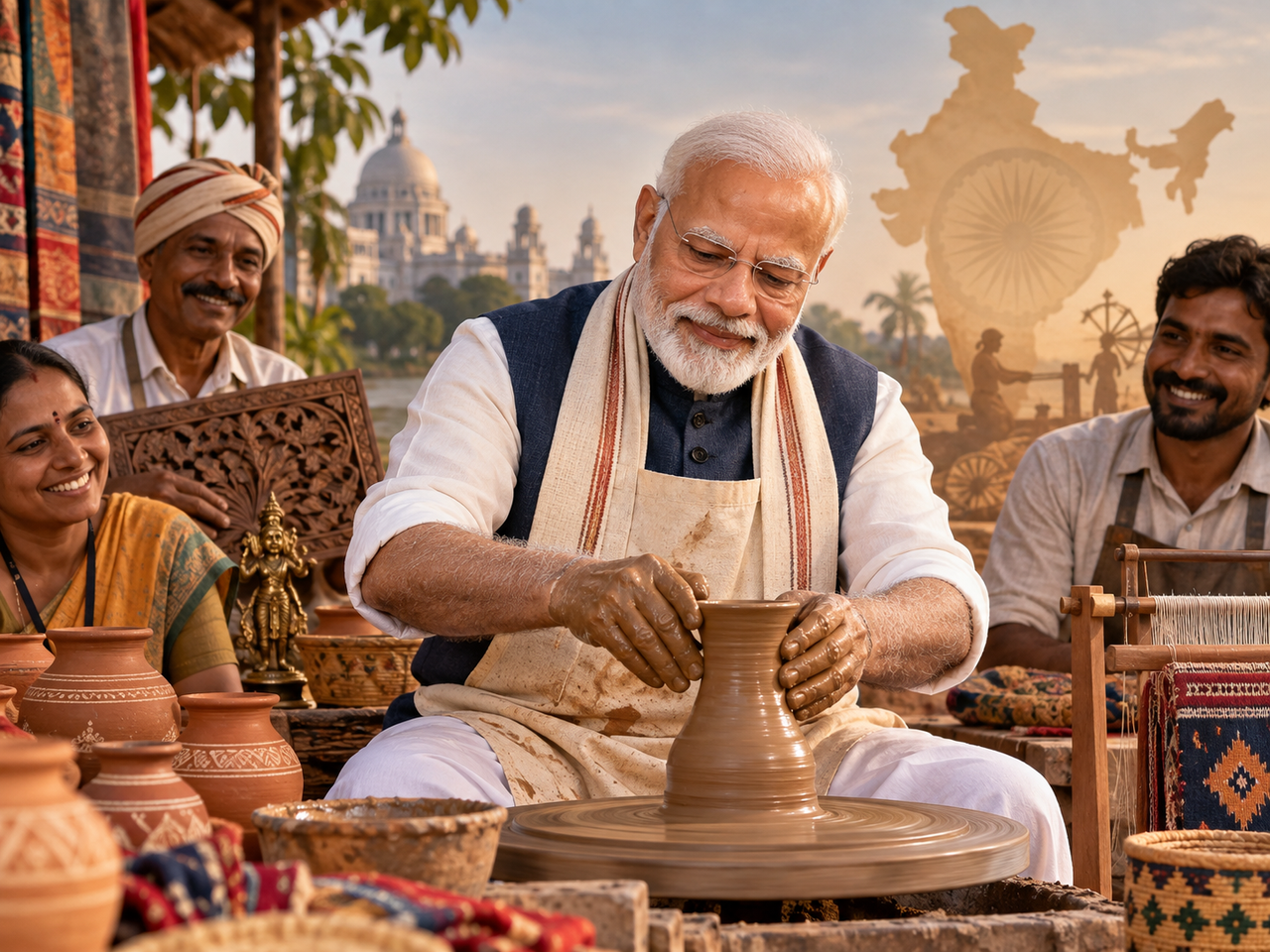
The bigger economic test is whether a carpenter, potter, blacksmith, tailor, cobbler or other traditional craftsperson can use the training, tools and credit to increase productivity, reach larger markets and build a business that earns more consistently.
That question was at the centre of the third-anniversary celebrations of PM Vishwakarma in Kolkata, where the Ministry of Micro, Small & Medium Enterprises highlighted the progress of the scheme and its expansion into West Bengal.
Launched on September 17, 2023, PM Vishwakarma was built around 18 traditional trades. Its support extends from formal recognition and skill training to modern toolkits, collateral-free credit and market access. The stated objective is not merely to preserve traditional skills, but to help the people carrying those skills become stronger economic participants.
/fit-in/580x348/filters:format(webp)/tice-news-prod/media/media_files/2026/09/18/pm-vishwakarma-at-3-2026-09-18-15-05-45.png)
The First Milestone Was Bringing Artisans Into the System
Traditional artisans have long formed part of India’s informal economy. Their businesses are often small, family-run and dependent on inherited skills.
What they frequently lack is not necessarily the ability to make something. It is access to the systems that allow a small craft business to grow — formal recognition, affordable finance, better equipment, digital transactions and customers beyond the local market.
PM Vishwakarma attempts to address that gap at the point where skill meets enterprise.
The scheme provides beneficiaries with a certificate and identity card, basic and advanced training, a toolkit incentive of up to ₹15,000, and access to collateral-free enterprise development loans. Basic training lasts five to seven days, with advanced training extending to 15 days or more. Trainees are also eligible for a ₹500 daily stipend during training.
The numbers suggest considerable uptake.
Of the 30 lakh registered beneficiaries, about 24.50 lakh have received basic skill training. That means the programme has moved well beyond registration for a large share of its beneficiaries.
The next step is harder to measure: what changed in the business after the training?
/fit-in/580x348/filters:format(webp)/tice-news-prod/media/media_files/2026/09/18/pm-vishwakarma-kolkata-2026-09-18-15-06-33.jpg)
A Better Toolkit Can Change the Economics of a Small Workshop
For an artisan, a tool is not just an asset. It can determine how quickly a product is made, how much material is wasted and how consistent the final product becomes.
PM Vishwakarma has delivered 18.15 lakh modern toolkits through India Post, according to the MSME Ministry.
Consider a small tailoring unit. Better equipment could increase the number of orders handled in a day. For a carpenter, improved tools can change finishing quality and production time. For a potter, better equipment can affect output and consistency.
The economic value comes only when that improvement translates into sales.
That is why the toolkit component cannot be viewed in isolation. Productivity has to travel through the rest of the business chain — from production to pricing, from pricing to demand and from demand to repeat orders.
The same applies to training.
Learning a new technique matters if it allows an artisan to make a better product, enter a new category or command a better price.
Credit Is Where a Livelihood Can Start Becoming a Business
The scheme’s credit numbers offer another indication of how far the programme has moved into enterprise development.
So far, 6.18 lakh Vishwakarmas have received loans of up to ₹1 lakh at a concessional interest rate of 5% a year, with total disbursement reaching ₹5,297 crore. The scheme provides further credit support through a second tranche, taking the potential loan amount to ₹3 lakh for eligible beneficiaries.
For a micro-enterprise, that money can have a very practical purpose: buying raw material, replacing machinery, increasing production or taking on a larger order.
But borrowing also introduces a different discipline.
A business that takes credit has to generate sufficient revenue to repay it. That makes customer demand as important as access to capital.
This is where PM Vishwakarma moves beyond the traditional boundaries of an artisan-support programme. The question becomes whether public support can help create businesses that eventually generate their own momentum.
/fit-in/580x348/filters:format(webp)/tice-news-prod/media/media_files/2026/09/18/suvendu-adhikari-2026-09-18-15-07-51.jpg)
The Market May Decide Whether the Scheme Scales
India has no shortage of traditional crafts. The constraint is often visibility.
An artisan may have a good product but operate within a market defined by the village, town or a handful of local buyers. Digital commerce changes that equation, but only if the artisan can actually participate in it.
PM Vishwakarma therefore includes market-linkage support, including opportunities through exhibitions, trade fairs, e-commerce platforms and the Government e-Marketplace. Beneficiaries can also be brought into the wider formal MSME ecosystem through platforms such as Udyam Assist.
This could become one of the most important parts of the programme.
A larger market can justify better equipment. Better equipment can support larger orders. Larger orders can make working-capital finance more useful.
But that chain works only when the customer is there.
For traditional artisans, the journey from local craft to wider market involves packaging, branding, quality consistency, logistics, digital payments and the ability to fulfil orders on time.
The skill may be centuries old. The business around it has to operate in today’s economy.
West Bengal Is Now the Next Implementation Test
West Bengal brings a new dimension to the programme.
The state was onboarded for implementation of PM Vishwakarma only in May 2026. At the Kolkata anniversary event, the state government said it had received more than 7 lakh applications under the scheme and would strengthen facilitative support so eligible artisans could access its benefits.
The state’s traditional craft base makes the rollout particularly significant.
But implementation at this scale is rarely about a single ministry.
Verification, training, banking, tool delivery, digital onboarding and market access all have to work together. The Kolkata event brought more than 2,000 Vishwakarmas and panchayat functionaries from different districts together, along with officials from the Centre, state government, banks, India Post and other agencies.
That gives West Bengal a practical task: ensuring that the scheme does not stop at applications and certificates.
The real test will be what happens inside the workshops, homes and small businesses that receive the support.
/fit-in/580x348/filters:format(webp)/tice-news-prod/media/media_files/2026/09/18/pm-vishvakarma-yojana-2026-09-18-15-08-29.jpg)
The 30-Lakh Milestone Is Not the Finish Line
PM Vishwakarma has reached the 30-lakh beneficiary mark three years after its launch, while its broader implementation period runs through FY2027-28. The scheme has an outlay of ₹13,000 crore.
That leaves time for the numbers to tell a different story.
Registrations will remain important. So will training and credit disbursement. But the more revealing indicators will emerge further down the chain: how many artisans increase production, enter new markets, take repeat credit, formalise their enterprises and improve their earnings.
That is ultimately the distinction between supporting an artisan and building an entrepreneur.
India’s traditional crafts already possess something many startups spend years trying to create: a product identity, a human skill and a story rooted in place.
What PM Vishwakarma is attempting to add is the business infrastructure around that skill.
If it can connect the artisan’s hands to better tools, affordable capital and customers beyond the local market, the scheme’s biggest achievement may not be the 30 lakh registrations. It may be the number of small enterprises that emerge from them.