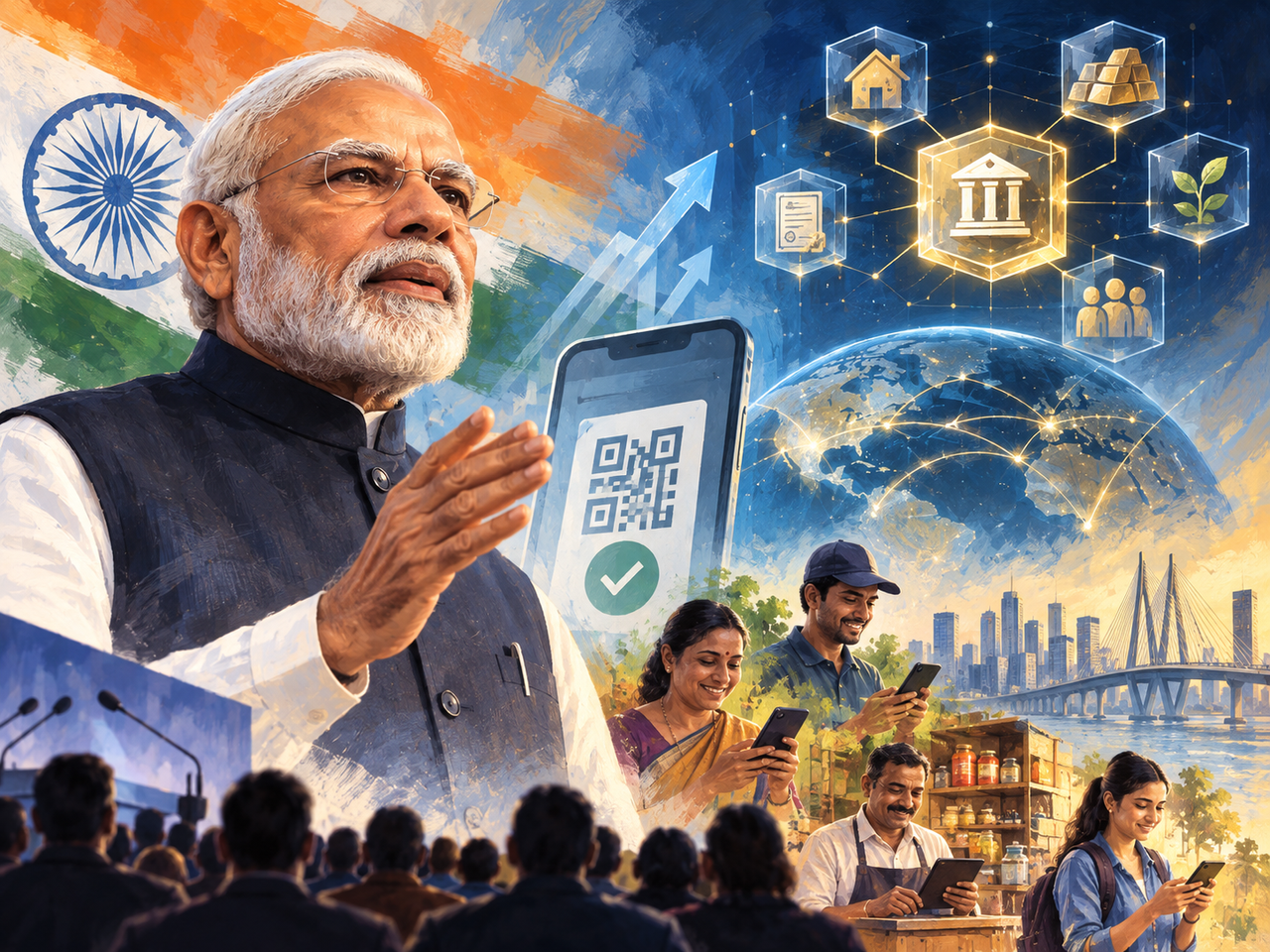

Prime Minister Narendra Modi wants India’s fintech industry to look beyond UPI. Speaking at the 7th Global Fintech Fest in Mumbai, he pointed to tokenisation, agentic AI and quantum technology as technologies that could reshape financial services. His reference to tokenisation in India opens up a broader question: what comes after the country’s digital payments revolution?
The timing is significant.
UPI has spent the past decade solving one of India’s most visible financial frictions: moving money instantly, cheaply and at massive scale. Modi’s message at GFF 2026 was that this success cannot become the industry’s endpoint.
The next horizon, he argued, lies in expanding formal finance across credit, insurance, savings, investments and pensions, particularly for people and small businesses that traditional financial models have struggled to serve.
That is where his reference to tokenisation becomes interesting.
India Has Built the Payment Rails—Now What?
Modi highlighted UPI’s decade-long journey. The platform completed 10 years on August 25 and, according to the Prime Minister, processed more than 2,400 crore transactions in August alone. He also said UPI is now live in 11 countries and argued that India should go further by connecting it with more international payment systems. Official government data puts August’s UPI transaction volume at 24,509 million, or roughly 2,451 crore transactions.
But his broader point was about what comes after payments.
A small shopkeeper, Modi explained, may receive digital payments every day. Over time, those transactions create a clearer picture of the business—its income, expenses and growth. That information can potentially help a lender understand a business that may still be too small or informal for traditional credit models.
The same logic can apply to delivery workers and others outside conventional financial systems, giving them easier access to savings, insurance and pension products.
In other words, payments can become the entry point into a much broader financial relationship.
That is the next fintech challenge Modi is putting before the industry.
Why Tokenisation in India Changes the Paradigm
Tokenisation in India takes that conversation into another territory.
GFF 2026’s official framework describes tokenisation as transforming assets into programmable digital units, enabling fractional ownership, instant settlement and interoperable money. The broader proposition is that tokenisation could unlock liquidity and reshape areas ranging from capital markets to payments and financial participation.
That moves the discussion well beyond its early association with cryptocurrency.
The bigger idea is the ability to represent an asset or financial claim digitally and attach rules to how it can be owned, transferred or settled.
That could eventually have implications for areas such as securities, collateral, trade finance, investment products and other financial assets. GFF’s own 2026 programme includes tokenised assets and market infrastructure among its wealth and capital-markets tracks.
But a digital token does not automatically create trust.
Someone still has to establish ownership. KYC and eligibility still have to be verified. Legal claims still need to be enforceable. And there has to be accountability when something goes wrong.
That is why the regulatory part of Modi’s speech matters as much as the technology.
The Real Opportunity May Be the Infrastructure
For Indian startups, the most interesting opportunity may not be a consumer-facing tokenised product.
It could be the infrastructure underneath it.
Potential areas include:
- Tokenisation and issuance rails: Platforms to issue, manage and audit digital assets.
- Identity and compliance: Systems for KYC, eligibility and ownership verification.
- Digital custody and asset servicing: Infrastructure to securely hold and manage tokenised assets.
- Interoperability: Connecting tokenised financial assets with existing banking and payment systems.
- Risk and cybersecurity: Protecting programmable assets and financial transactions from new forms of digital exploitation.
There is a useful parallel with UPI.
The biggest innovation was not simply another payment app. It was the common infrastructure underneath those apps.
Tokenisation could create a similar opportunity—although the legal, regulatory and technological questions are considerably more complex.
For founders, that means the interesting companies may not be the ones that simply put an asset on-chain. They may be the ones that make the underlying system usable, compliant and trustworthy for banks, investors and businesses.
Tokenisation Will Need Trust, Not Just Speed
Modi also laid out four priorities for the fintech industry: stronger cybersecurity, industry-level ethical data protection standards, a stronger regulator-industry innovation ecosystem and a Fintech Consumer Protection Index that could transparently rate companies.
Those priorities become particularly important as finance becomes more programmable.
A system that can execute transactions automatically can also scale errors automatically. A tokenised asset may make ownership easier to transfer, but it also raises questions around custody, fraud, consumer protection and legal enforcement.
The next generation of fintech therefore cannot be built only around speed.
It will have to be built around trust that can scale with the technology.
The Next Opportunity Is to Build the Rails for Tokenisation
For India’s fintech founders, the opportunity in Tokenisation in India is not simply to create another financial product. It is to build the infrastructure that can make ownership, investment and financial value more programmable, transferable and accessible. Much like UPI created the rails on which an entire generation of payment businesses was built, tokenisation could create a new layer of financial infrastructure around assets and ownership. The technology is still at an early stage, and its success will depend on regulation, trust, cybersecurity and interoperability. But if India can build those foundations right, tokenisation could move from a technology conversation to the next phase of the country’s digital financial architecture.
Editorial Note
This story is based on Prime Minister Narendra Modi’s address at the 7th Global Fintech Fest 2026 and official material released by the Government of India and Global Fintech Fest. TICE has edited and contextualised the speech for editorial clarity. The discussion of startup opportunities and potential applications of tokenisation represents TICE’s editorial analysis and should not be read as announced government policy.