Crypto charity has a familiar shape. A project announces a giving initiative, usually timed to a launch or a token event. There’s a press release, a percentage, sometimes a photo. Months later, nobody can say what happened to the money, and nobody is asking. The people who cared have moved on. This isn’t a story about one project. It’s a pattern, old enough that a skeptical reader’s first reaction to “crypto for good” is: which flavor of this is it.
Why Does Crypto Charity Keep Failing the Same Way?
The failures are structural, not moral. They trace to how the giving is attached to the project, not to bad intent.
- A donation announcement is a claim, not a receipt. Unless a project publishes exactly where the funds went and lets anyone check, “we donated” reads the same whether it’s true or not. Readers can’t tell from outside, and most projects don’t let them check from inside either.
- Giving is usually a campaign, not a property of the token itself. It gets announced alongside a launch, runs for a while, and ends, not because anyone decided to stop, but because nobody owned keeping it going. The team that cared moves on, and the giving quietly becomes a line in an old announcement.
- Nothing forces continuity. A charitable percentage that lives in a blog post or a tweet is a promise that depends on someone remembering to keep it, and nothing in the code, the token, or the market requires it. When the goodwill that started it fades, so does the giving, usually without any record marking the moment it stopped.
Together, these three problems describe a category, not a company. Plenty of crypto projects have meant every word of their giving announcements. The pattern persists anyway, because sincerity was never the weak link. The mechanism was.
What Changes When Giving Is Built Into the Token Instead of Announced Alongside It?
On PUMPCHANGE, the donation is a property of the token, fixed before the token exists, not a commitment added after the fact.
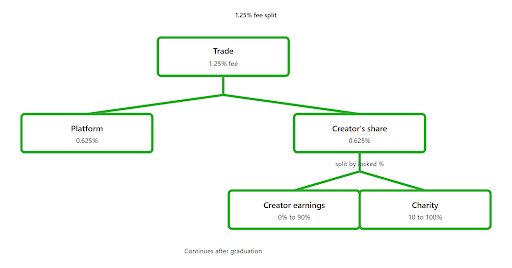
PUMPCHANGE is a Solana meme coin launchpad. Every token launched on PUMPCHANGE has a charitable donation built into its trading fees. A creator picks a charity and locks in a donation percentage (between 10% and 100% of their share of trading fees) in the same step where they choose the token’s name and logo. The create-coin form states the consequence directly: “Choose carefully, these cannot be changed once the coin is created.” A 1.25% fee applies to every buy and sell; half goes to the platform, and the other half is split between the creator and their chosen charity according to the percentage the creator set. Once locked, that percentage will apply to every trade automatically, and will continue after the token graduates to open-market trading. The same charity crypto donation mechanism will apply to every token the launchpad hosts, not a special case for any one creator. Creators who want to pick their cause before the token exists can already join the waitlist at pumpchange.fun/waitlist.
That’s the difference between a mechanism and an announcement. An announced giving initiative depends on someone continuing to act: renewing the commitment, processing the transfer, deciding not to quietly wind it down. A donation set at the protocol level doesn’t ask anyone to keep doing anything. Every trade will route a share to charity by construction, whether the creator is still paying attention, whether the project is trending, whether anyone remembers the launch happened. Nobody has to remember to donate, and nobody can quietly stop.
That changes what’s worth asking. The question isn’t whether a project will keep its promise; it’s whether the mechanism that pays out requires anyone to keep a promise at all. For giving that’s structural rather than declared, only the second version of that question matters.

How Does This Compare With pump.fun’s Charity Coins?
pump.fun runs a comparable feature, and the difference comes down to timing: when the donation gets fixed.
On pump.fun, Charity Coins route creator fees through Donate.gg to a nonprofit’s page (Nonprofit Newsfeed, July 2026); pump.fun’s own public documentation doesn’t specify whether the charity or the percentage can be changed once a coin has already launched. On PUMPCHANGE, that question doesn’t come up: the charity and the percentage are locked in the same step as the token’s name and logo, before the token exists, and the create-coin form states it directly: “Choose carefully, these cannot be changed once the coin is created.”
A setting that can change after launch depends on someone continuing to choose it, which is the exact failure mode the opening section of this piece describes. A setting locked before the token exists doesn’t carry that dependency, whoever ends up running the project later on.
How Is This Different From a Project Just Saying It Gives to Charity?
At launch, the claim will come with a way to check it, not just a way to state it.
Fees will accumulate rather than being distributed on every trade, and will be paid out at regular intervals. Payout details, including blockchain transaction hashes, will be published at the bottom of each token page alongside the trade history. The Payments tab on each token will show total fees collected, creator earnings and the share allocated to charity. The charity’s name, website and the fee breakdown will appear on the token’s page, before anyone trades it. The platform is built so that anyone will be able to check where the money went, without asking.
That’s a different claim than “we donate to charity.” It’s closer to “here’s the transaction you’ll be able to look up.” A record on a public blockchain doesn’t require trusting the project’s word; it requires knowing how to read a transaction hash, a much lower bar, and one the platform is designed to invite.
The difference, side by side:
| Campaign-based giving | Protocol-level giving | |
|---|---|---|
| When it’s set | Announced after launch, often tied to a promotional moment | Locked at token creation, before trading starts |
| Who has to act to keep it going | The team, continuously | Nobody. It’s automatic on every trade |
| How you verify it happened | Take the announcement’s word for it | The payout and transaction hash will be checkable |
| What ends it | Attention moving on, with no formal stopping point | Nothing, short of the token no longer trading |
| Who can quietly stop it | Whoever ran the campaign | Nobody |
The left column is most of what’s been tried in crypto charity. The right column is a different design, not a different level of sincerity.

Does a Built-in Mechanism Solve the Whole Problem?
Mostly: the mechanism solves continuity, and it also solves where the money goes. What it can’t solve is what happens after that.
At launch, a share of every trade will be provably earmarked for a charity, on-chain, before anyone trades. That’s continuity: nobody forgetting, nobody quietly stopping. Delivery is just as concrete: PUMPCHANGE sends the SOL directly to the charity’s own Gemini account, a regulated custodian, set up for that charity by The Giving Block. A payout hash won’t resolve to an anonymous wallet. It resolves to a specific account belonging to a specific charity.
What that doesn’t confirm is what happens after the SOL lands: whether it’s converted, spent, or put to the use the charity described when it signed up. That last step sits outside what any transaction hash can prove, here or anywhere else donations move on-chain.
Most giving-focused crypto projects never get this specific about where the money goes. It’s easy to describe a mechanism that generates a donation. It’s much rarer to name the exact account it lands in, and naming it is what turns “we donate to charity” into something a reader can actually check.
- Checkable at launch: the locked percentage, every payout’s transaction hash, and the specific charity account it lands in.
- Not checkable, even then: what the charity does with the money once it’s there.
What This Changes
The gap described above, between what happens on-chain and what a charity does with the money afterward, doesn’t close just because delivery is now concrete. Still, it’s worth naming exactly which problems the mechanism actually solves. Crypto charity’s biggest failure mode was never the absence of good intentions. It was the absence of anything forcing those intentions to outlast the announcement that made them, and the absence of anywhere specific for the money to go. A donation that’s a property of the token, applied automatically, paid to a named account, and checkable by anyone, closes both of those gaps. What the charity does once the money arrives is still a separate question, one worth asking directly rather than assuming answered. This is what crypto for good looks like on a Solana meme coin launchpad: a mechanism instead of a marketing line.
Tokens are created and traded on Raydium, an open-source Solana protocol; PUMPCHANGE provides the interface. Meme tokens on PUMPCHANGE are for entertainment, not equity or profit share, and the giving mechanism doesn’t change that. The platform isn’t available to users in New York or California, and is for adults 18 and over. Blockchain transactions, including a donation transaction, are irreversible once confirmed.
At launch, the locked percentage, the fee breakdown, and the payout history with transaction hashes will be visible on every token page.
The waitlist is open at pumpchange.fun/waitlist.
The post Crypto for Good: Why PUMPCHANGE Believes Meme Coins Can Give Back appeared first on Ventureburn.