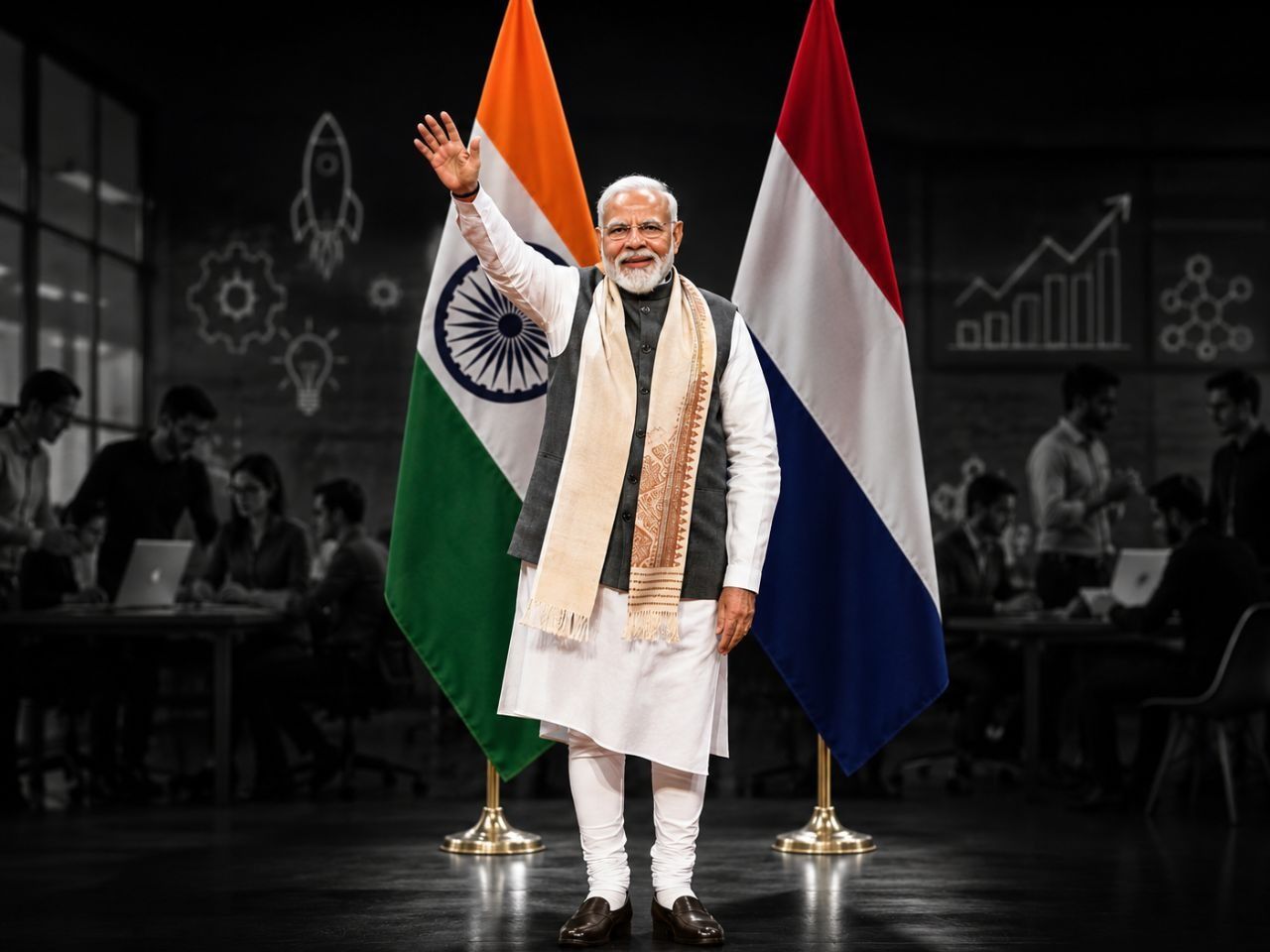

As the world grapples with economic uncertainty, geopolitical tensions and an intensifying energy crisis, Prime Minister Narendra Modi used his visit to the Netherlands to project a very different narrative — one of ambition, technology, entrepreneurship and scale.
Addressing a packed gathering of the Indian diaspora in The Hague, Modi painted a picture of an India that is rapidly transforming itself through startups, digital innovation, manufacturing and clean energy expansion. The speech, delivered amid growing global concerns around slowing economies and fractured supply chains, was both a celebration of India’s progress and a pitch for deeper global collaboration.
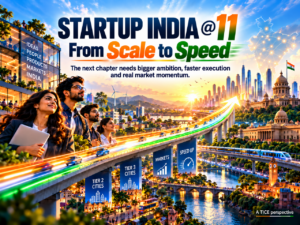
At the centre of his message was India’s startup ecosystem — a sector Modi described as one of the strongest symbols of the country’s changing economic identity.
“India is moving ahead with unlimited aspirations and limitless efforts,” the Prime Minister said, highlighting how innovation and entrepreneurship are increasingly shaping the country’s growth story.
India’s Startup Ecosystem Takes Centre Stage
Modi underlined how dramatically India’s startup landscape has evolved over the past decade.
“Twelve years ago, India had fewer than 500 startups. Today, the number has crossed over 200,000,” he said, adding that nearly 44,000 startups have already been registered in 2025 alone.
The numbers reflect the extraordinary pace at which India’s entrepreneurial ecosystem has expanded. Once dominated largely by e-commerce and consumer internet companies, the country’s startup ecosystem is now spreading across deeptech, artificial intelligence, semiconductors, defence innovation, mobility, climate tech and space technology.
According to Modi, India currently has around 125 active unicorns, with several startups now building globally competitive technologies from within the country.
The Prime Minister especially highlighted the role of India’s youth in driving this transformation. He noted that young entrepreneurs are increasingly entering sectors such as AI, drone manufacturing and advanced electronics — industries that are becoming strategically important worldwide.
India is now widely recognised as the world’s third-largest startup ecosystem, and Modi’s remarks reflected the government’s attempt to position the country not merely as a market for technology, but as a creator of it.
Digital India’s Massive Scale
Beyond startups, Modi used the occasion to spotlight India’s digital infrastructure revolution — an area the government frequently presents as a model for other nations.
The Prime Minister said India now records more than 20 billion UPI transactions every month, accounting for over half of the world’s digital transactions globally.
From digital payments to paperless governance systems, Modi said India’s digital public infrastructure has scaled at a pace rarely seen anywhere else in the world.
“Whether it is digital wallets, DigiLocker, DigiYatra or digital health IDs, India’s digital transformation is happening at an unprecedented scale,” he said.
The comments come at a time when India’s digital public infrastructure model is increasingly attracting international attention. Countries across Asia, Africa and Europe have shown interest in learning from India’s low-cost, population-scale technology systems, especially UPI and Aadhaar-linked digital services.
For India’s startup ecosystem, this infrastructure has also become a powerful growth enabler. Fintech, healthtech, logistics and SaaS startups have all benefited from the widespread adoption of digital identity, digital payments and mobile-first public systems.
Semiconductor Push Signals Manufacturing Ambitions
One of the key themes of Modi’s address was India’s growing focus on advanced manufacturing and strategic technologies.
The Prime Minister said work is currently underway on 12 semiconductor plants across the country, with production already beginning at two facilities.
The semiconductor sector has become a major global priority after recent chip shortages disrupted industries ranging from automobiles to electronics. India has been aggressively trying to position itself as an alternative manufacturing and supply-chain destination amid global geopolitical realignments.
Modi’s remarks signalled that India wants to move beyond software and services into high-value manufacturing ecosystems.
The semiconductor push is also closely tied to India’s broader ambition of becoming a global manufacturing hub. Over the last few years, the government has introduced incentive schemes across electronics, renewable energy, battery manufacturing and strategic sectors to attract global investments into the country.
Green Energy and Infrastructure Expansion
Infrastructure and clean energy development formed another major pillar of the Prime Minister’s speech.
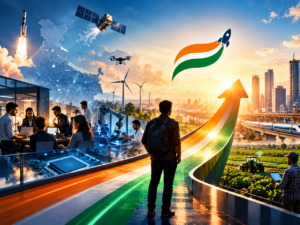
Modi said India is rapidly expanding highways, metro rail systems, electrified railway networks, airports and renewable energy projects while simultaneously building some of the world’s largest solar parks.
“India wants to become a global manufacturing hub, a green energy leader and the world’s growth engine,” he said.
The Prime Minister also highlighted growing cooperation between India and the Netherlands in green hydrogen and sustainable energy solutions. As countries worldwide look for alternatives to fossil fuels and attempt to secure long-term energy stability, green hydrogen has emerged as a strategic area of collaboration.
India’s renewable energy expansion has become increasingly important not just from a climate perspective, but also from an economic and geopolitical standpoint. Reducing import dependence and strengthening energy security are now central to India’s long-term growth strategy.
Warning Over Global Energy Crisis and Economic Uncertainty
While much of the speech focused on India’s rise, Modi also issued a strong warning about the broader global situation.
He said the world is currently facing severe disruptions caused by the aftereffects of the COVID-19 pandemic, geopolitical conflicts and a worsening energy crisis.
“This decade is becoming a decade of disasters for the world,” Modi said.
“If these conditions are not changed rapidly, many achievements of previous decades could be wiped out and a large population could once again fall into poverty.”
The comments reflected growing concerns among global leaders around inflation, supply-chain instability, energy insecurity and slowing economic growth across multiple regions.
Modi stressed the need for resilient, transparent and trusted supply chains, particularly in sectors linked to energy, technology and essential infrastructure.
He said India and the Netherlands are working together on future-ready supply chains in areas such as energy security, water management and green hydrogen.
Netherlands as a Strategic Gateway to Europe
The Prime Minister also pointed to the growing economic relationship between India and the Netherlands.
He said the recently concluded trade agreement between India and the European Union would help deepen economic ties further while positioning the Netherlands as a strategic gateway for Indian businesses looking to expand into Europe.
The Netherlands has increasingly become an important trade and investment partner for India, particularly in sectors such as logistics, clean energy, agriculture technology and water management.
For Indian startups and businesses seeking European expansion, the country is often viewed as a key entry point into the broader EU market because of its strong logistics network and business connectivity.
Diaspora Described as a “Living Bridge”
Modi reserved special praise for the Indian diaspora in the Netherlands, calling them a “living bridge” between the two countries.
He said the Indian community continues to strengthen economic, cultural and technological ties while helping connect India’s ambitions with European markets and standards.
Indian diaspora communities have increasingly become influential participants in global business and innovation ecosystems, particularly in technology, research and entrepreneurship sectors across Europe and North America.
Democracy, Political Stability and India’s Growth Story
The Prime Minister also spoke about India’s democratic scale and political transformation.
Referring to the 2024 Lok Sabha elections, Modi noted that more than 64 crore people voted — a figure larger than the population of the European Union.
According to him, rising voter participation reflects growing public confidence in India’s democratic institutions and development trajectory.
Modi also reflected on his own political journey, recalling May 16, 2014 — the day his government came to power with a full majority after decades of coalition politics.
He said the continued support and trust of citizens motivate him to work towards transforming India into a developed nation.
By combining themes of startups, digital infrastructure, manufacturing, clean energy and democratic participation, Modi’s address in The Hague ultimately served as a larger statement about how India wants to position itself in a rapidly changing global order — not just as a fast-growing economy, but as a technology-driven nation aiming to play a central role in shaping the future global landscape.