
“Delhi’s charms are unpredictable. In beauty resides horror, and vice versa.”
In his earlier literary work Dilli Se Hoon..!!, Ateesh Kumar Singh captured Delhi not as a city, but as a living contradiction — chaotic yet charismatic, cynical yet hopeful, bruised yet endlessly alive. The observation feels particularly fitting for the Ateesh Kumar Singh DPIIT journey — a bureaucrat who has spent over three decades navigating India’s own institutional contradictions across Railways, Finance, MSME, and now the Department for Promotion of Industry and Internal Trade (DPIIT).
That tension between chaos and reinvention also defines modern India’s economic story in 2026 — a nation simultaneously rebuilding its infrastructure, digitizing commerce, empowering MSMEs, accelerating startup innovation, and reimagining industrial growth. Few bureaucrats have worked across those transitions as closely as Ateesh Kumar Singh.
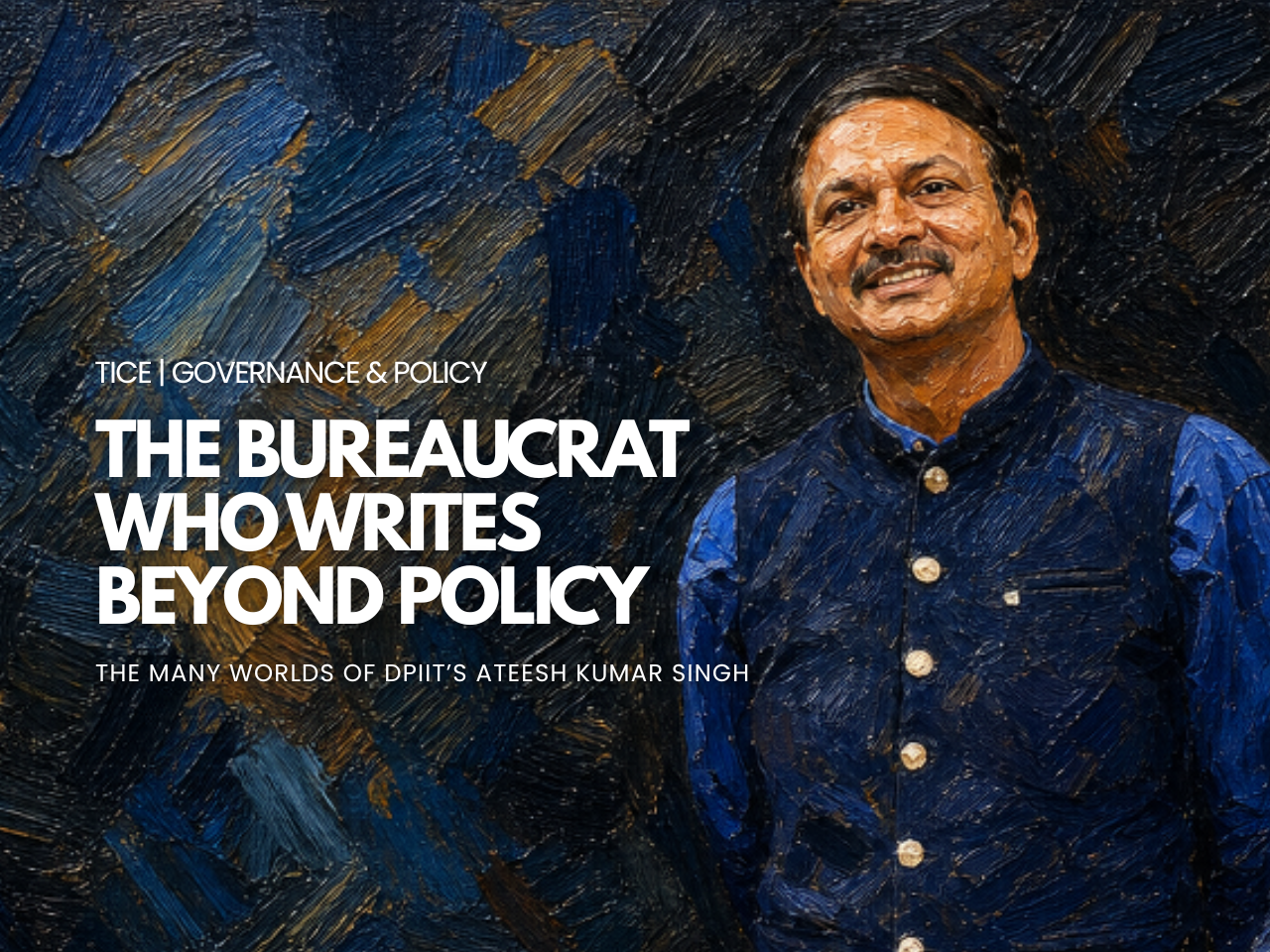
Ateesh Kumar Singh, an Indian Railway Traffic Service (IRTS) officer, was appointed as Additional Secretary in DPIIT in December 2025. In April 2026, he was also given charge of Startup India. His current responsibilities span Internal Trade, E-commerce, Startup India, and Logistics — placing him at the center of some of India’s most important economic, industrial, and entrepreneurial missions.
/fit-in/580x348/filters:format(webp)/tice-news-prod/media/media_files/2026/05/15/ateesh-kr-singh-2026-05-15-22-17-07.png)
With Startup India now under his leadership, Singh’s role extends beyond industrial policy into the future of India’s entrepreneurial economy.
The timing is significant.
As global supply chains shift and India pushes to become a manufacturing and innovation hub, DPIIT has emerged as one of the government’s most strategically important departments. From PM Gati Shakti and industrial corridors to startup policy, logistics integration, ONDC, and ease of doing business reforms, the department now sits at the intersection of infrastructure, industry, technology, and entrepreneurship.
Singh’s latest book, Beyond Growth: India’s Industrial Reset, appears to reflect many of those shifts. The book explores how India’s corporate landscape is undergoing a quiet yet powerful renaissance rooted in ethics, transparency, and accountability — themes increasingly shaping India’s governance and economic discourse.
That blend of policy execution and reflective writing makes Singh stand out in India’s administrative landscape. Over the years, he has helped shape initiatives linked to PM Gati Shakti, MSME modernization, startup financing frameworks, green transition programs, and digital commerce systems.
Now, across Internal Trade, E-commerce, Startup India, and Logistics at DPIIT, many of those experiences converge at one place.
/fit-in/580x348/filters:format(webp)/tice-news-prod/media/media_files/2026/05/15/ateesh-kr-singh-10-2026-05-15-22-33-54.png)
The Officer at the Core of PM Gati Shakti
At DPIIT, Ateesh Kumar Singh is leading one of the government’s most ambitious infrastructure integration exercises — PM Gati Shakti National Master Plan.
The initiative seeks to integrate highways, railways, ports, airports, logistics parks, and industrial corridors into a synchronized national infrastructure network aimed at reducing logistics costs and strengthening India’s manufacturing competitiveness.
Singh heads the Network Planning Group (NPG), which brings together multiple infrastructure ministries and departments for unified planning and coordination.
He is also coordinating with states and Union Territories on logistics plans while engaging with multilateral agencies on future infrastructure projects.
For India Inc., PM Gati Shakti is more than a connectivity mission. It is a foundational economic strategy designed to improve supply chains, lower logistics costs, and support India’s ambition of becoming a global manufacturing hub.
/fit-in/580x348/filters:format(webp)/tice-news-prod/media/media_files/2026/05/15/ateesh-kumar-singh-dpiit-2026-05-15-22-28-25.png)
The Railway Officer Who Helped Shape Modern Mobility
Long before integrated infrastructure became a national policy buzzword, Singh was managing some of the country’s most complex railway operations.
During his tenure in the Ministry of Railways, he handled train operations, commercial management, urban transport planning, manpower coordination, project execution, and freight operations across Northern India.
He later contributed to the conceptualization and operationalization of India’s first single-set Vande Bharat Express trains connecting Delhi with Varanasi and Katra.
He also played a role in introducing India’s first private train operations in the Delhi-Lucknow and Varanasi-Ujjain sectors.
Within the Railway Board, Singh headed the Non-Fare Revenue Directorate, where he worked on alternative revenue generation strategies for Indian Railways.
Those assignments built his reputation as an administrator who combines operational depth with long-term systems thinking.
/fit-in/580x348/filters:format(webp)/tice-news-prod/media/media_files/2026/05/15/ateesh-kr-singh-9-2026-05-15-22-32-27.png)
The MSME Reformer Focused on Scale and Sustainability
If Railways gave Singh operational experience, the Ministry of MSME established him as a policy reformer.
Over the years, he led policy formulation around MSME credit, sustainability, innovation, technology adoption, and market access.
One of his most significant contributions was spearheading the RAMP (Raising and Accelerating MSME Performance) program, a World Bank-supported initiative with an outlay of Rs 6,000 crore.
The program focused on improving competitiveness and productivity in the MSME sector while strengthening state-level convergence and implementation.
Singh also conceptualized nationwide green transition initiatives for MSMEs, including programs linked to green technologies, circular economy adoption, and sustainability-driven financing.
He played a role in UNIDO-backed decarbonization and energy-efficiency projects for MSMEs as well.
At a time when climate-linked industrial policy is becoming central to India’s economic strategy, Singh’s experience in sustainability-focused MSME reforms assumes added relevance.
/fit-in/580x348/filters:format(webp)/tice-news-prod/media/media_files/2026/05/15/ateesh-kr-singh-5-2026-05-15-22-29-00.png)
Building Digital Public Infrastructure for Small Businesses
One of the defining aspects of Singh’s policy journey has been his work on digital governance systems for MSMEs.
He led the development of an AI-powered Online Dispute Resolution (ODR) mechanism aimed at resolving delayed payment disputes for small businesses.
He also worked on conceptualizing digital commerce systems and strengthening digital support infrastructure for MSMEs.
In addition, Singh headed the CHAMPIONS portal, a grievance redressal and support platform for MSMEs launched during a critical period for small enterprises.
These initiatives reflect a governance approach increasingly shaping India’s policy architecture — using digital public infrastructure to improve inclusion, efficiency, and scalability.
/fit-in/580x348/filters:format(webp)/tice-news-prod/media/media_files/2026/05/15/ateesh-kr-singh-2-2026-05-15-22-30-18.png)
ONDC, Startup India and the New Innovation Economy
Singh’s policy footprint also extends deep into India’s startup and digital commerce landscape.
With Startup India now under his leadership, Singh will help shape policy at a time when India is pushing to deepen innovation-led growth and entrepreneurship.
He also served on the board of ONDC (Open Network for Digital Commerce) from 2022 to January 2026.
ONDC is widely seen as one of India’s most ambitious attempts to democratize e-commerce by enabling interoperable digital networks for businesses of all sizes.
Earlier, during his tenure in the Ministry of Finance, Singh worked on several major public financial products including PM Mudra Yojana, Stand-Up India, startup-focused Fund of Funds, and multiple credit guarantee frameworks.
He was also directly involved in establishing the National Credit Guarantee Trust Corporation of India (NCGTC), envisioned as the umbrella institution for India’s credit guarantee framework.
His work on TReDS reforms, receivables financing systems, and delayed payment mechanisms positioned him at the center of discussions around MSME liquidity and financial architecture.
For startups and MSMEs, these are not abstract policy frameworks. They directly influence access to credit, cash flow stability, and growth opportunities.
/fit-in/580x348/filters:format(webp)/tice-news-prod/media/media_files/2026/05/15/ateesh-kr-singh-8-2026-05-15-22-29-34.png)
The Bureaucrat Who Writes Beyond Policy
Away from government corridors, Ateesh Kumar Singh has steadily built a parallel identity as a writer and commentator.
He is the author of My Derailments With Truth, a spoof on bureaucracy, and Thou Stickest a Dagger in Me, a satire inspired by Shakespeare’s Merchant of Venice.
His latest work, Beyond Growth: India’s Industrial Reset, signals a deeper engagement with the changing moral and governance foundations of corporate India.
The book explores how India’s industrial and corporate landscape is entering a new phase shaped not just by growth metrics, but also by ethics, transparency, accountability, and institutional responsibility.
That evolution closely mirrors India’s broader economic transition itself.
Singh has also authored articles in Financial Express and The Economic Times on topics ranging from MSME green reforms and receivables financing to AI for MSMEs and ethical capitalism.
It is a rare combination: a senior bureaucrat equally comfortable discussing logistics infrastructure, credit architecture, digital commerce, startup innovation, and literary satire.
/fit-in/580x348/filters:format(webp)/tice-news-prod/media/media_files/2026/05/15/beyond-growth-2026-05-15-22-31-27.png)
Why His Role Matters in 2026
Ateesh Kumar Singh’s expanded role comes at a defining moment for India’s economic ambitions.
DPIIT today sits at the intersection of manufacturing policy, Startup India, logistics modernization, industrial corridors, digital commerce expansion, and ease of doing business reforms.
India is simultaneously trying to strengthen supply chains, accelerate manufacturing, support MSME digitization, scale digital commerce networks, and position itself as a global innovation hub.
Few administrators have worked across infrastructure, finance, MSME policy, sustainability, logistics, and digital systems in the way Singh has.
That cross-sector experience could become increasingly valuable as India moves toward a more interconnected economic architecture where startups, manufacturing, logistics, green transition, and digital public infrastructure are no longer separate conversations.
In many ways, Ateesh Kumar Singh’s career mirrors the India he writes about — layered, restless, ambitious, occasionally contradictory, but always moving forward.
From railway corridors and startup finance to digital commerce and industrial policy, his journey reflects the evolution of a country trying to move beyond growth numbers toward something larger: resilient institutions, ethical capitalism, and smarter systems.
Perhaps that is what India’s industrial reset truly demands — not just faster growth, but better governance.