
India’s startup and business ecosystem witnessed another high-voltage news cycle today, with major developments spanning deep-tech funding, AI policy, banking reforms, semiconductor expansion, political shifts in key industrial states, and the broader employment landscape shaped by artificial intelligence.
From Hyderabad-based space-tech startup Skyroot becoming India’s first unicorn in the private space sector to Maharashtra unveiling an ambitious AI roadmap worth ₹10,000 crore in investments, the day reflected how India’s economic growth story is increasingly being driven by technology, manufacturing, and policy-led innovation.
At the same time, political changes in states like West Bengal and Tamil Nadu could have long-term implications for industrial policy, manufacturing investments, and startup ecosystems in these regions.
Here’s TICE.news’ comprehensive roundup of the top developments shaping India’s startup, business, economy, and governance landscape today.
Top Business & Economy News Today
1. Skyroot Becomes India’s First Space-Tech Unicorn
Hyderabad-based space startup Skyroot Aerospace entered the unicorn club after raising $60 million in a funding round led by GIC and Sherpalo Ventures, with participation from BlackRock. The company’s valuation has now crossed $1.1 billion, making it India’s first space-tech unicorn.
Skyroot gained national attention after successfully launching India’s first privately developed rocket in 2022. The fresh capital will now be used for scaling launch frequency, manufacturing capabilities, and developing the Vikram-2 launch vehicle.
2. Maharashtra Launches Aggressive AI Policy
The Maharashtra government unveiled a new Artificial Intelligence policy aimed at attracting over ₹10,000 crore in investments and generating nearly 1.5 lakh jobs by 2030-31.
The policy includes capital subsidies, AI incubators, Centres of Excellence, AI innovation cities, and skill development initiatives. The state also plans to support 5,000 MSMEs in adopting AI technologies while building GPU infrastructure for AI startups and enterprises.
3. SBI Eyes Massive Credit Expansion Under ECLGS 5.0
State Bank of India Chairman CS Setty said the latest Emergency Credit Line Guarantee Scheme (ECLGS 5.0) could enable SBI to open ₹70,000–₹80,000 crore worth of fresh credit lines.
The move is expected to provide significant liquidity support to businesses, especially MSMEs and sectors still recovering from economic stress. Banking leaders indicated implementation may begin within days.
4. Government Clears New Semiconductor Projects Worth ₹3,936 Crore
India’s semiconductor ambitions received another boost after the government approved two semiconductor manufacturing projects worth ₹3,936 crore.
The approvals come under the India Semiconductor Mission, which aims to strengthen domestic chip manufacturing capabilities and reduce import dependence. The move is also expected to improve India’s positioning in the global electronics supply chain.
5. AI-Led Layoffs Continue Across Global Tech Sector
The global technology industry has reportedly seen more than 93,000 job cuts across 106 companies in 2026 so far, as firms accelerate AI-driven restructuring and automation.
Companies including Freshworks and Coinbase are among those undertaking workforce reductions. The trend reflects the rapid transformation of the tech industry, where companies are prioritising AI efficiency while reducing operational costs.
6. Tamil Nadu’s Political Shift Puts Industry on Watch
Actor-turned-politician Vijay’s Tamilaga Vettri Kazhagam (TVK) has emerged as a major political force in Tamil Nadu, creating uncertainty and optimism within India’s manufacturing hub.
Tamil Nadu hosts global manufacturing giants such as Apple suppliers, Samsung, Hyundai, and multiple electronics players. Industry leaders are now closely watching how the new political dynamics could impact industrial policy and investments in sectors like semiconductors, EVs, and electronics manufacturing.
7. West Bengal Sees Major Political Transition
West Bengal entered a fresh political phase after Governor RN Ravi dissolved the Mamata Banerjee cabinet following the recent Assembly election outcome.
The BJP is now preparing to form the government in the state for the first time. Political analysts believe the transition could significantly alter Bengal’s industrial and investment climate in the coming years.
8. Startup Ecosystem Continues Rapid Expansion
India’s startup ecosystem continues to scale rapidly, with government data showing that over 55,200 startups were officially recognised in FY26 — the highest annual addition since the launch of Startup India in 2016.
The recognised startups also contributed to a sharp rise in direct employment generation, reinforcing the sector’s growing role in India’s economic growth story.
9. Startup India Fund of Funds 2.0 Gains Momentum
The government’s ₹10,000 crore Startup India Fund of Funds 2.0 initiative is increasingly becoming central to India’s deep-tech and early-stage startup push.
The scheme aims to support startups in AI, semiconductor technology, robotics, defence-tech, and advanced manufacturing — sectors that are now emerging as India’s next growth frontier.
10. India’s GenAI Startup Landscape Faces Reality Check
India’s first GenAI unicorn Krutrim is reportedly shifting focus towards cloud services amid rising costs associated with building foundational AI models.
The development reflects broader global concerns around the economics of large AI models and highlights how Indian AI startups may increasingly prioritise monetisation and infrastructure services over expensive model training.
11. Focus Shifts From “Idea” to “Execution” in Startup Ecosystem
The Economic Times and Cashfree Payments launched the “One Of A Kind Startup Awards 2026,” focusing specifically on startups demonstrating strong go-to-market execution and scalability.
The initiative reflects a broader investor sentiment shift where startups are increasingly being evaluated on sustainable growth, profitability, and market execution rather than pure valuation metrics.
12. India’s Startup Base Crosses New Milestones
Industry estimates suggest India now hosts more than 2.23 lakh startups, including over 128 unicorns, making it the world’s third-largest startup ecosystem after the United States and China.
Deep-tech, AI, fintech, SaaS, climate-tech, and manufacturing startups are expected to dominate the next wave of entrepreneurial growth in the country.
Conclusion
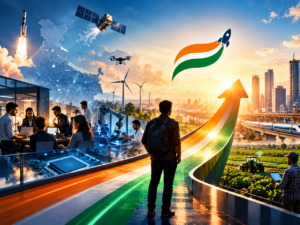
Today’s developments underline a larger transformation underway in India’s economic and startup ecosystem. Deep-tech sectors such as AI, semiconductors, and space-tech are increasingly becoming national priorities, backed by strong policy support and rising investor confidence.
At the same time, political transitions in industrially significant states, rising AI-led disruptions in global employment, and the shift toward sustainable startup growth indicate that India’s business landscape is entering a more mature and competitive phase.
For startups, investors, policymakers, and entrepreneurs alike, May 7, 2026, was another reminder that India’s growth story is no longer limited to consumer internet ventures — it is rapidly expanding into infrastructure, manufacturing, deep technology, and global-scale innovation.