If you’ve spent any time around crypto, you’ve probably heard people throw around terms like mining, hashing, or mining rigs like it’s common knowledge. However, it may be confusing to some. What is cryptocurrency mining then?
Whether you are a curious investor or a tech-savvy hobbyist, it’s important to understand what mining entails to help you navigate the digital economy. This guide will break the technical barrier down, and in simple terms, you will understand what mining is, how it works and the pros and cons of mining.
What is Cryptocurrency Mining?
Cryptocurrency mining, in the simplest of terms, is the validation of transactions and their connection to a network of blockchains. Let’s use this example. Whenever an individual sends a crypto transfer (like Bitcoin), the transfer should be confirmed.
Miners intervene to verify such transactions and package them into blocks. The block is added to the blockchain when it is validated. Mining companies compensate this labor by giving miners new coins and part of the commission paid by people.
So when people ask “what is crypto mining?”, the simple answer is: It is how decentralized networks can be kept safe and how new coins are brought into the market. The procedure is not centralized and thus the banks or middlemen do not get involved. A network of competing computers that maintains a blockchain.
How Does Crypto Mining Work? (PoW & Hashing)

Crypto Mining. Image Credit: FinanceFeeds
In order to know how does crypto mining work, you need to get your hands on the hood of the Proof of Work (PoW) consensus mechanism. The majority of large cryptocurrencies (such as Bitcoin) use this Proof of Work (PoW) consensus mechanism. And it should be noted that crypto mining is mostly limited to Proof-of-Work cryptos.
PoW blockchains consist of blocks with data on transactions. A challenging mathematical problem must be solved by the miners to add a new block to the chain. This puzzle is related to a hashing process. A hash is a unique digital signature generated by a signed algorithm (Bitcoin SHA-256).
Miners guess a specific number, also referred to as the nonce (number used once) with their computers. This nonce, together with the information in the block, should yield a hash that satisfies some specific requirements.
Since it is impossible to determine the output of a hash, miners have to make trillions of guesses per second. It is this work that makes the network secure. It authenticates a blockchain against bad actors who would like to alter its history. To complete this task, the network that the miners keep secure rewards them with cryptocurrencies.
How to Mine Crypto: Hardware, Pools & Cloud Mining
If you’re wondering how to mine crypto, there are three main paths you can take:
- Hardware Mining: You purchase dedicated hardware (typically GPUs or ASICs). Then install crypto mining software and begin to mine
- Mining Pools: A cryptocurrency mining pool is formed by a group of miners who pool their computing capabilities together to get a higher chance of solving a block.
- Cloud Mining: Cryptocurrency cloud mining is where a remote data center rents out the computing power. You pay an upfront fee and get a portion of mining power and rewards. Check the best crypto mining platforms to get the best deals.
What is a Cryptocurrency Mining Rig?
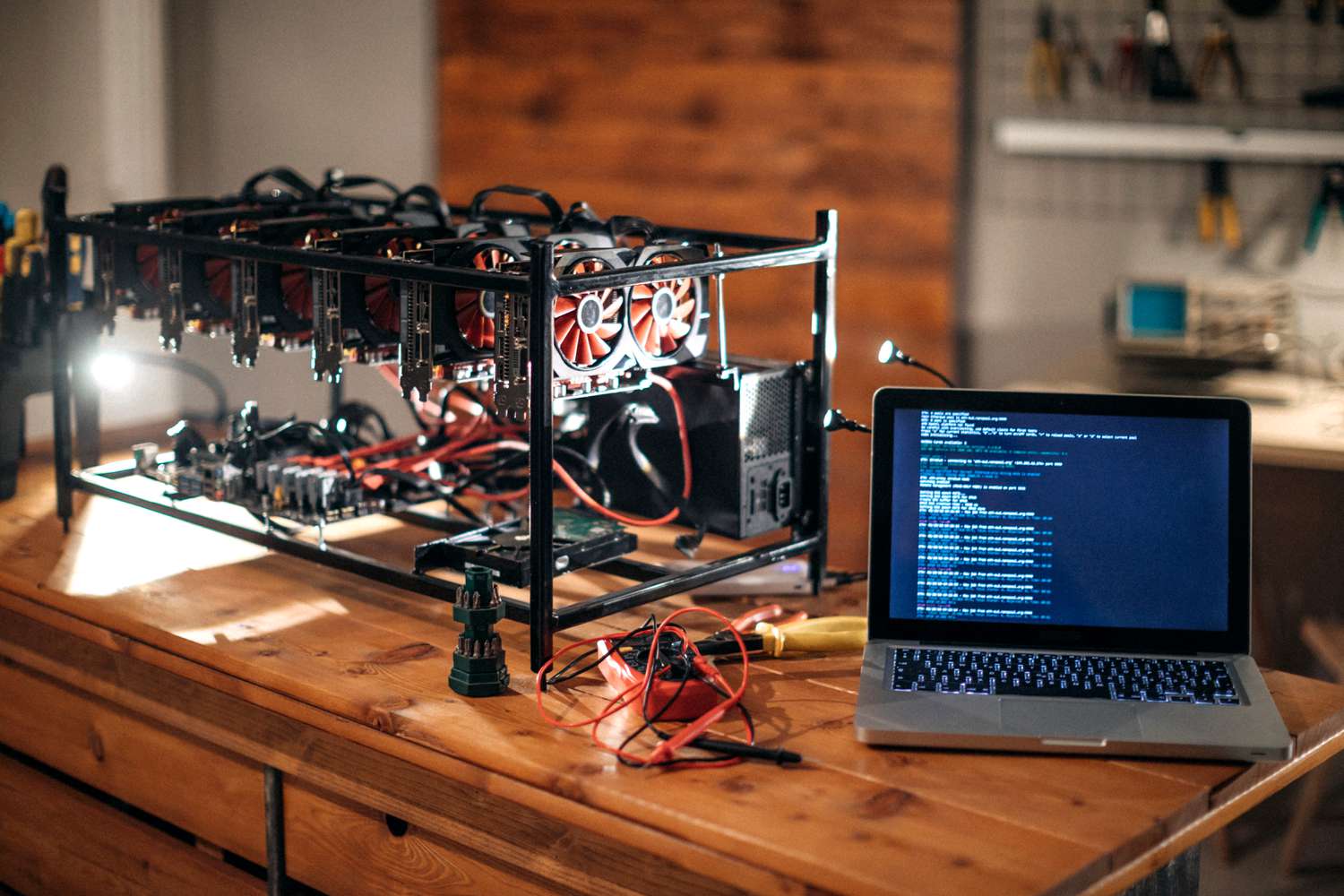
A cryptocurrency mining rig is a specially designed computer system that is used to perform the hashing activity. These rigs are not just regular PCs but emphasize raw processing power and cooling.
A proper mining rig includes:
- Graphics cards (GPUs) or ASIC miners
- Power supply unit (PSU)
- Cooling system
- Motherboard & processor
- Crypto mining software
When a person inquires, what is a cryptocurrency mining rig, simply imagine: It is the engine that drives your mining process. Rigs can be of two types:
- GPU Rigs: GPU Rigs are based on mining high-end graphics cards (from NVIDIA or AMD) to mine altcoins such as Monero or Ravencoin. You can also use GPU rigs for gaming and video editing.

Crypto Mining Graphics Cards. Image Credit: Greggio
- ASIC (Application-Specific Integrated Circuit) Miners: An ASIC miner has been designed to mine a single algorithm (like Bitcoin’s SHA-256 hash). They are more efficient since they focus on one algorithm.

Crypto Mining ASIC. Image Credit: BiTBO
Solo Mining vs. What is a Cryptocurrency Mining Pool?
As the name implies, in solo mining, you mine alone. The advantages are that you can control all of your setup and you retain 100% of the profit. Nevertheless, due to increasing network difficulty, there is an extremely small probability that a single machine will solve a block.
This is the reason why majority of miners enter a cryptocurrency mining pool. In this case, you unite with other people. To find solutions more often, many miners unite or aggregate their computing power. The advantages include regular payouts and decreased entry point. The payouts are far less since you have to share with people in the pool, and fees are very high, depending on the platform you use.
What is Cryptocurrency Cloud Mining?

Crypto Mining Farm. Image Credit: Tokize
Cryptocurrency cloud mining is an option for those who wish to avoid the noise and heat, as well as electricity bills of a physical rig. In this model, you pay a fee to a company that owns massive farms of mining equipment.
You essentially rent a portion of their hashing power for a set period. It is the easiest form of mining as it doesn’t require owning or managing a rig. While this lowers the barrier to entry, it comes with risks. The profits are usually not as advertised by operators, and they usually require long contracts.
Pros of Cryptocurrency Mining
Now we know how to mine crypto, let’s look at the upsides it presents.
- Passive Income: Once set up, a rig can generate rewards 24/7.
- Potential for High ROI: If you mine a coin while it’s cheap and its value later explodes, the returns can be astronomical. Miners often research coin price prediction before they begin mining.
- Supports Decentralization: Miners are the core of the blockchain, making it safe and inaccessible to a central authority.
- Hardware Value: GPU rigs have a tendency to be resold in the secondary gaming market with some value.
Cons of Cryptocurrency Mining
Next, we will discuss the possible negative aspects of cryptocurrency mining.
- Expensive Electricity: Mining is power-hungry- this will take up profits quickly.
- Hardware Depreciation: Technology is a fast-paced thing. The state-of-the-art ASIC today could be a paperweight in just two years.
- Volatility: Overnight, the price of the coins you mined can go down, making a good business a loss.
- Regulatory Scrutiny: Governments are putting an increasing emphasis on the tax consequences and the impact of mining on the environment.
Conclusion: Should You Start Mining Crypto?
In comparison to the early days, crypto mining is not the plug and play money maker that drew masses. And now it is an efficiency game. Nevertheless, due to the necessity of mining to the operation of cryptocurrencies, the practice is still a profitable business.
To the hobbyist, getting into a pool or mining less-competitive altcoins is the most realistic. Calculate your electricity rate and hardware cost before expanding into mining, and use a profitability calculator in mining. This will give you a fair idea of how much to expect.
>>> Read More: What Is CEX in Crypto? Guide to Centralized Exchanges
FAQs About Cryptocurrency Mining
Is mining Bitcoin illegal?
Most developed nations have legalized Bitcoin mining. But certain nations, such as China and others, have prohibited it owing to either capital flight or energy use. In any case, consult your local regulator.
What is crypto mining?
It’s the process of verifying transactions on a blockchain and earning rewards in the form of new coins.
How much can I earn from crypto mining?
Profitability is determined by three factors. The current price of the coin, how much you pay per kilowatt-hour of electricity (kWH), and the hash rate of your equipment. Provided you do your research, crypto mining can be highly profitable.
Are crypto mining rewards taxable?
Yes. Many other tax authorities tax crypto rewards as gross income when you receive them. You can also pay capital gains tax in case you sell those coins later at a profit.
What is the most profitable coin to mine?
This changes daily. Bitcoin is the most well-known, but numerous miners get higher margins when working on the altcoins, such as Ravencoin, Ergo, or Litecoin.
The post What Is Cryptocurrency Mining & How Does It Work? appeared first on Ventureburn.