
There’s something poetic about aiming for the skies on Independence Day.
For Pune-based space-tech startup Astrophel Aerospace, August 15, 2026 is more than just a symbolic date—it’s a bold statement. A statement about technological independence, about building from within, and about India’s growing confidence in its private space ecosystem.
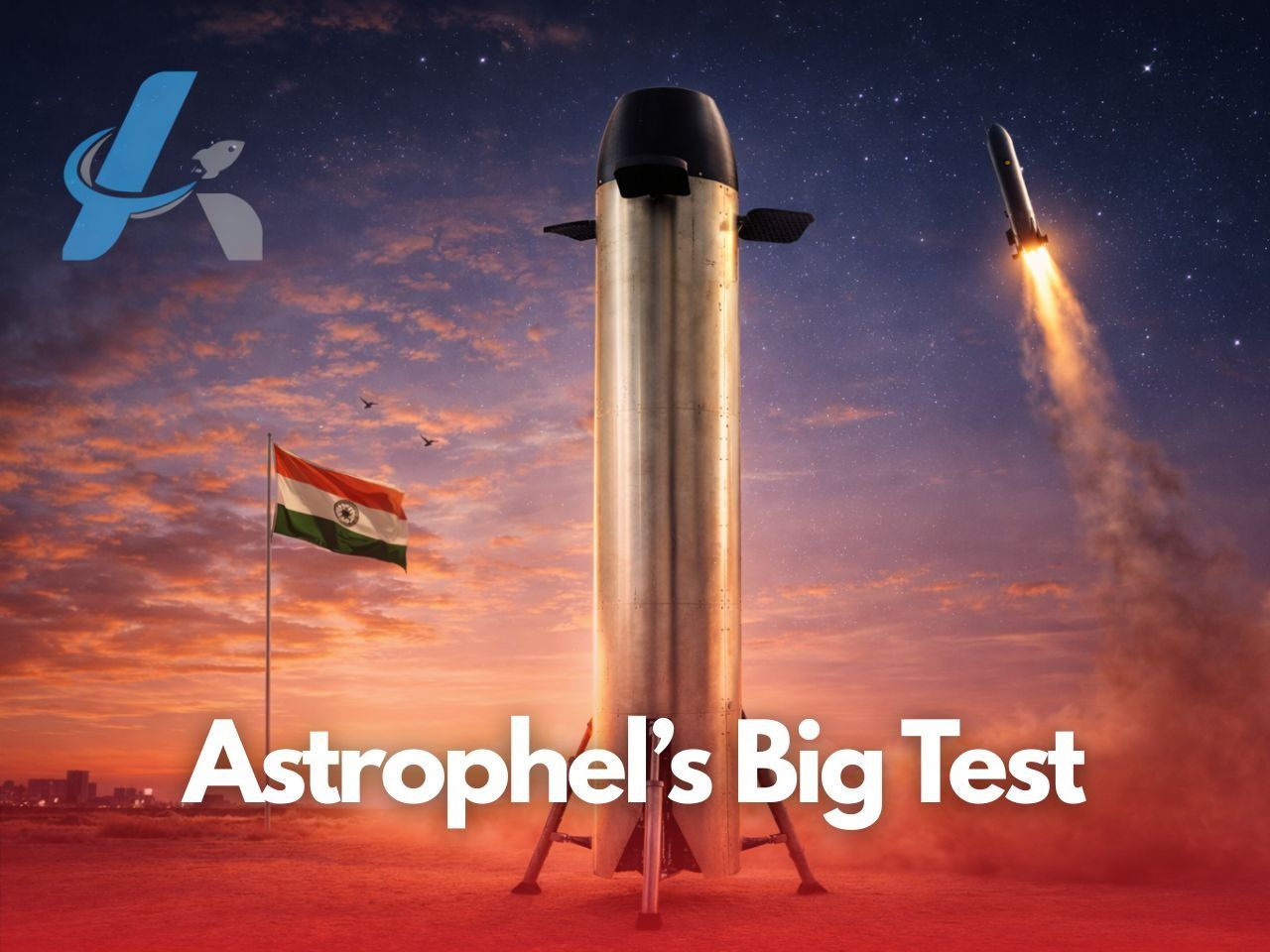
On that day, if all goes to plan, a 3-metre-tall rocket prototype—compact, weighing just around 200 kilograms—will rise vertically into the sky and return gracefully to land. It won’t reach orbit. It won’t carry satellites. But what it represents could be far bigger.
It could mark one of the earliest successful demonstrations of a privately built, fully indigenous reusable rocket prototype in India.
A Small Rocket With Big Ambitions
At the center of this milestone is Astrophel’s suborbital reusable rocket prototype, designed using the VTVL (Vertical Takeoff and Vertical Landing) approach—the same fundamental principle that has reshaped global spaceflight economics.
Often referred to as a “hopper,” this prototype is currently being designed, manufactured, and assembled entirely in-house at the company’s Pune facility. Its purpose is not commercial deployment—yet. Instead, it serves as a testbed, a proving ground for something much more critical: the building blocks of future launch systems.
A successful flight would validate not just the rocket’s flight capability, but also the complex cryogenic and propulsion subsystems that power it.
Building the Backbone: India-Made Cryogenic Systems
While rockets capture imagination, the real engineering story often lies beneath the surface—in components rarely seen but absolutely essential.
Astrophel Aerospace has been quietly building a comprehensive portfolio of ‘Made-in-India’ propulsion and cryogenic subsystems. This includes:
- High-performance cryogenic control valves
- Advanced turbopumps
- Vacuum-insulated cryogenic storage tanks
- High-speed precision linear actuators
The recent development of these cryogenic control valves marks a significant step—not just for the company, but for India’s broader private aerospace manufacturing ecosystem, which still depends heavily on imports.
As Co-founder and CEO Suyash Bafna puts it, the upcoming test could be among the first instances of a reusable rocket prototype built entirely within India’s private sector ecosystem.
From Milestones to Momentum
This isn’t Astrophel’s first brush with a symbolic Independence Day milestone.
Back on August 15, 2023, the startup successfully conducted a cryogenic engine test—a complex engineering feat achieved by only a handful of players in India’s private space sector.
Since then, the company has steadily built momentum, including raising over $800,000 in funding last year. But more importantly, it has focused on something deeper than funding headlines: vertical integration.
By designing and manufacturing critical subsystems in-house, Astrophel is creating a tightly controlled hardware ecosystem. This approach allows for:
- Faster development cycles
- Better performance optimization
- Seamless integration across industries
And those industries extend far beyond space—from defense and aerospace to oil & gas, and even emerging sectors like green hydrogen.
A Cost Advantage That Could Change the Game
Co-founder and COO Immanuel Louis highlights another crucial angle: cost.
Drawing inspiration from automotive manufacturing practices, the company believes it can develop these subsystems at approximately 40% lower cost than global competitors.
In a sector where costs often dictate access, this isn’t just an operational advantage—it could be a strategic lever for India’s positioning in the global space economy.
Solving a Growing Bottleneck in Space
The timing of Astrophel’s push couldn’t be more relevant.
Today, most satellite operators depend on rideshare launch programs—a system where multiple payloads share a single rocket. While cost-effective, these missions often face delays, scheduling constraints, and limited flexibility.
At the same time, the demand curve is exploding.
According to Goldman Sachs Research, over 70,000 low Earth orbit (LEO) satellites are expected to be launched over the next five years.
This surge is creating a clear need for faster, more flexible, and cost-effective launch solutions—and that’s where reusability becomes critical.
Beyond Rockets: A Strategic Business Model
Interestingly, Astrophel isn’t betting everything on launching rockets into orbit—at least not immediately.
Instead, the company is taking a dual-path approach:
- Developing reusable launch vehicle capabilities
- Generating revenue through component sales and licensing
By supplying high-performance propulsion and cryogenic systems to other players, Astrophel is effectively building an ecosystem play, not just a launch business.
This strategy helps de-risk the long journey to orbit, while simultaneously addressing a key industry gap: the lack of accessible, high-quality, locally manufactured components.
A Defining Moment on the Horizon
If successful, the August 15 test won’t just be another technical milestone.
It will signal something deeper—that India’s private space startups are not only participating in the global space race, but are beginning to build the core technologies themselves.
A small rocket lifting off from Indian soil, built entirely within the country, landing back with precision—it’s the kind of image that captures both ambition and intent.
And perhaps, in many ways, that’s what makes this upcoming test more than just a flight.
It’s a glimpse into the future of India’s space independence.
Disclaimer: This press release has been provided by the corporate communication/PR team of the respective organization. TICE neither verifies nor endorses the claims made and shall not be held responsible for their accuracy. The content may have been edited for style or clarity without altering the facts as provided. Any business or financial decision made on the basis of this content is at the reader’s sole discretion and risk. For any dispute regarding this content, please contact editorial@tice.news.