
There are moments when an ecosystem doesn’t just grow — it shifts gears.
This week feels like one of those moments for India’s startup and technology landscape.
From Prime Minister Narendra Modi’s high-level discussions with Google CEO Sundar Pichai to billion-dollar global investment commitments, from deep-tech growth funds to AI-powered healthcare tools built in Indian languages — the message is unmistakable: India is not just participating in the global AI race. It is positioning itself to shape it.
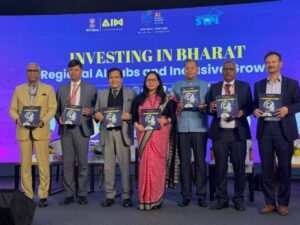
At the heart of it all was the India AI Impact Summit 2026 in New Delhi, which brought together policymakers, global technology leaders, investors, and founders. But beyond the headlines and handshakes, what unfolded across the ecosystem tells a deeper story — of capital, conviction, and capability converging at once.
Top Startup News Today
A National Push: PM Modi and Sundar Pichai on India’s AI Ambitions
The spotlight firmly turned to AI when Narendra Modi met Sundar Pichai, CEO of Google and Alphabet Inc., on the sidelines of the India AI Impact Summit 2026 in New Delhi.
The conversation focused on accelerating India’s artificial intelligence ambitions and deepening Google’s role in talent development, digital infrastructure, and sectoral transformation.
In a post on X, the Prime Minister highlighted India’s ongoing AI work and discussed how Google could collaborate with the country’s talented students and professionals in the field.
The meeting wasn’t just symbolic. It reflected India’s increasing importance in the global AI value chain — as both a market and a talent hub.
Global Capital Signals Confidence in the Global South
If policy conversations set the tone, capital commitments reinforced it.
Microsoft announced it is on track to invest $50 billion by the end of the decade to help bring AI capabilities to countries across the Global South. The company also outlined a five-pronged strategy to bridge the AI gap between the Global North and South, underscoring the need for infrastructure, skills, and access.
Meanwhile, semiconductor giant Qualcomm committed an additional $150 million to its AI venture fund to back Indian startups through Qualcomm Ventures. The focus: AI-driven innovation in automotive, IoT, robotics, and mobile.
These announcements, made during the summit, reflect a clear shift — India is no longer just a services destination. It is becoming a core AI innovation market.
OpenAI Bets on India’s Classrooms
AI’s future depends on talent — and that talent is being shaped today.
OpenAI announced partnerships with higher education institutions across India to embed artificial intelligence into learning and research. The move aims to strengthen AI use among students and build AI-ready talent for a changing job market.
As automation reshapes workplace skills, this collaboration is positioned as a critical step in strengthening India’s national capability in an increasingly digital global economy.
A Reality Check: AI Still Has Limits
Amid the excitement, a note of caution came from Demis Hassabis, CEO of DeepMind.
Hassabis argued that AI systems perform best in domains where answers can be definitively checked. More subjective fields — such as public policy — where there is no clear “right” answer, remain difficult for machines to master.
The distinction between objective, rule-based systems and judgment-driven domains is an important reminder: while AI is powerful, it is not universally ready to replace human decision-making.
The Startup Story: Innovation on the Ground
While global giants made big announcements, Indian startups continued building.
Arrowhead: Rethinking Conversational AI
Bengaluru-based AI startup Arrowhead is working on conversational AI systems designed to directly impact business outcomes.
The company envisions voice agents capable of engaging in natural conversations for up to 20 minutes — without customers realising they are speaking to AI. More importantly, these AI agents aim to achieve business outcomes comparable to top-performing human call-centre agents.
For decades, banks and NBFCs have relied on large call-centre teams for sales, collections, and renewals — a model that is expensive, inconsistent, and hard to scale. Arrowhead is attempting to change that equation.
Funding Momentum Across Sectors
Capital continued flowing across fintech, semiconductors, deep tech, real estate AI, and space.
Udtara Ventures Launches Rs 250 Crore Growth Fund
Venture capital firm Udtara Ventures announced a Rs 250 crore Udtara Growth Fund focused on deep-tech and defence companies with global relevance.
The fund plans to take meaningful ownership stakes in 8–10 growth-stage companies developing commercially deployable systems with confirmed order books and proven product-market fit.
Stable Money Raises $25 Million
Bengaluru-based fixed-income investment platform Stable Money raised $25 million in a pre-Series C round, led by Peak XV Partners with participation from Z47, RTP Global, and Fundamentum Partnership.
Founded in 2022 by Saurabh Jain and Harish Reddy, the raise takes the company’s total funding to $65 million.
Vervesemi Secures $10 Million for Semiconductor Innovation
Fab-less semiconductor startup Vervesemi raised $10 million in a Series A round led by Ashish Kacholia and Unicorn India Ventures, with participation from Roots Ventures, Caperize Fina, and MAIQ Growth Scheme.
Founded in 2017, the company will use the capital to commercialise its machine learning capabilities, expand its analog signal chain IC portfolio, productise existing silicon chips, and invest in R&D.
Earth Fund Makes First Investment
Earth Fund invested Rs 20 crore in Truboard Partners, which provides an AI-based asset performance platform for lenders, equity investors, developers, and asset owners in real estate and financial assets.
Truboard aggregates portfolio data for performance monitoring and analytics across multi-asset portfolios. The company operates across India’s real estate and energy markets and has expanded into the US and EU.
Earth Fund’s backers include HDFC Capital Advisors Limited and Nila Spaces, while sponsors Brigade Enterprises Ltd. and Gruhas have committed more than half of the capital raised so far.
IN-SPACe Announces Rs 1 Crore Grant
India’s space sector promoter IN-SPACe announced a Rs 1 crore grant under the IN-SPACe Seed Fund Scheme for startups and MSMEs exploring AI applications in space activities.
The move signals growing interest in AI-powered space technologies — a frontier sector for India.
Expanding the AI Footprint
IIT Madras Global Research Foundation Heads to Dubai
IIT Madras Global Research Foundation will establish its first Applied Artificial Intelligence Innovation Centre at Dubai CommerCity.
In its initial phase, the centre will host six applied AI startups with a combined valuation of about $118 million and projected revenues of $281 million over five years. The initiative will focus on product development, IP creation, and collaboration with government and industry.
CoRover.ai Scales BharatGPT
CoRover.ai announced large-scale deployment of its multilingual AI platform BharatGPT, built on NVIDIA Nemotron Speech models.
The company also introduced BharatGPT DeskAI Appliance, a desktop system based on NVIDIA Grace Blackwell architecture designed to operate offline, along with BharatGPT Mini — a private offline AI appliance tailored for enterprise, defence, financial services, and public sector use.
The platform supports voice, video, and text interactions across sectors including customer support, public services, financial services, travel, and utilities.
Sovereign AI for Healthcare
BharatGen Technology Foundation and Amrita Vishwa Vidyapeetham signed an MoU to co-develop sovereign, multilingual AI systems for India’s healthcare sector.
Their initial focus is scaling Med-Sum, a medical summary tool offering real-time clinical voice-to-text transcription and automated clinical summaries in multiple Indian languages.
Industry Partnerships Strengthen the Ecosystem
Beyond AI infrastructure and funding, partnerships across sectors continued:
-
Go Digit General Insurance partnered with Anvayaa Kin Care to offer senior care support as part of wellness benefits.
-
ThunderPlus teamed up with Indofast Energy to integrate battery swapping facilities into EV charging hubs across major cities, with plans to scale to 250+ locations.
-
KOGO OS outlined its role as a sovereign AI infrastructure platform deployed in regulated and security-sensitive environments.
-
Prosus, Boston Consulting Group, and the Ministry of Electronics and Information Technology released a white paper titled AI for All: Catalysing Jobs, Growth, and Opportunity.
The report calls for shifting India’s AI strategy from automation-led efficiency to productivity, institutional capacity, and broader participation in the digital economy. It draws on India’s digital public infrastructure — including Jan Dhan, Aadhaar, UPI, Account Aggregator, and ONDC — as the foundation for scaled AI adoption.
It also suggests AI adoption is likely to generate roles in supervision, diagnostics, compliance, data operations, and digital advisory services.
Taken together, the day’s developments show a layered transformation:
-
Policy alignment at the highest levels
-
Global capital committing long-term bets
-
Indian startups building real-world AI systems
-
Funds targeting deep-tech and defence
-
Sovereign AI efforts in healthcare and infrastructure
-
Education institutions embedding AI at the core
India’s startup ecosystem has gone through funding winters and correction cycles. But what is unfolding now feels less like a cycle — and more like structural repositioning.
AI is no longer a buzzword in India’s startup story. It is becoming the backbone.
And if the signals from this week are any indication, India is not just preparing for the AI era — it is actively building it.