India’s startup ecosystem has emerged as a powerhouse of entrepreneurial energy over the past decade. Fueled by the Government of India’s Startup India initiative and accelerated by digital adoption, entrepreneurial ambition, and global investment interest, India today stands as one of the largest and fastest‑growing startup markets in the world.
Within this broad national phenomenon, individual states and union territories play a critical role in shaping the innovation landscape. Their unique policies, infrastructure investments, industry strengths, and cultural ecosystems not only determine the vibrancy of startups locally but also contribute to national economic growth, employment generation, and technological advancement. To objectively measure this performance, the States’ Startup Ranking Framework (SRF) created by the Department for Promotion of Industry and Internal Trade (DPIIT) evaluates all Indian states and UTs on their capacity to nurture startup ecosystems.
TICE News explores how Indian states rank in startup innovation, the key drivers behind their performance, what makes successful ecosystems thrive, lessons from top performers, and how emerging regions are positioning themselves for future growth.
1. Understanding the States’ Startup Ranking Framework (SRF)
The States’ Startup Ranking Framework was launched in 2018 to systematically evaluate the startup ecosystems across India’s states and union territories. Its primary goal is to assess how policy, infrastructure, mentorship, and market access contribute toward stimulating startups at various stages, from ideation to scale‑ups.
The Framework benchmarks states across multiple parameters like:
-
Policy environment: Dedicated state startup policies and reform actions.
-
Institutional support: Presence of incubation centers, accelerators, funding mechanisms, mentorship, and ecosystem‑building initiatives.
-
Access to market and procurement: Opportunities startups receive from government and corporate procurement.
-
Funding access: Ease of accessing seed capital, angel networks, VC interest, state‑sponsored funds, and Angel tax reliefs.
-
Infrastructure: Availability of physical spaces, digital connectivity, technology parks, and innovation districts.
By scoring and ranking states annually, SRF promotes competitiveness, encourages reform adoption, and highlights best practices for ecosystem building.
2. Top Performing States in India’s Startup Ecosystem
Though official SRF data for the latest ranking cycle (2025) isn’t widely public yet, credible estimates and ecosystem reports help construct a picture of the leading states driving innovation. Key performers typically combine strong policy support with industry depth, talent pools, and access to capital.
▸Karnataka: India’s Silicon Powerhouse
Karnataka and especially Bengaluru has consistently topped startup rankings in India. Its ecosystem benefits from decades of investment in technology, research institutions, and a skilled workforce.
-
In 2025, Karnataka reinforced its position with the Startup Policy 2025–2030, deploying an outlay of ₹518 crore to support ~25,000 startups and emphasize emerging technologies like AI, blockchain, and quantum computing.
-
Bengaluru, often dubbed India’s Silicon Valley, routinely ranks among the top global startup ecosystems, climbing to 14th place internationally in the Global Startup Ecosystem Rankings.
-
The region leads in unicorn creation, with over 50 unicorns credited to Karnataka startups far more than any other state.
Karnataka’s success stems from a synergistic mix of capital availability, global corporate presence, research institutions, and talent inflows from across India.
▸Maharashtra: Financial Capital Meets Innovation
Maharashtra home to Mumbai and Pune blends financial markets with deep‑tech innovation:
-
It consistently ranks near the top in tech startup presence and ecosystem strength. Maharashtra reported the highest number of tech startups in India according to recent ecosystem mapping.
-
It is tied with Haryana for the second highest number of unicorns (19).
What propels Maharashtra is the fusion of finance, media, and enterprise tech sectors enabling startups to tap into corporate partnerships and capital efficiently.
▸Tamil Nadu & Telangana: Manufacturing and Deep Tech Innovation
Tamil Nadu and Telangana continue rising as regional powerhouses:
-
Tamil Nadu’s startup ecosystem emphasizes manufacturing tech, SaaS, and CleanTech, with emerging hubs around Chennai and Coimbatore.
-
Telangana’s government recently announced a ₹1,000 crore Startup Fund and hosts India’s first Google for Startups Hub, signaling global integration.
Both states are rapidly building infrastructure and industry connections to bridge the gap between research and commercialization.
▸Delhi NCR & Haryana: Urban Innovation and Market Access
The National Capital Region incorporating Delhi, Noida, and Gurugram combines policy leadership, entrepreneurial energy, and access to national markets:
-
Delhi hosts 15 unicorns, supported by its rich talent pool and tech adoption.
-
Haryana is emerging strongly with over 9,500 recognized startups and a supportive state startup policy.
The NCR region especially excels in fintech, logistics, SaaS, and digital services, thanks to urban connectivity and high consumer demand.
▸Gujarat: Rapidly Rising Innovation Hub
In 2025, several reports indicate that Gujarat overtook other states in startup recognition:
-
Gujarat reportedly became the top state in startup ranking by the number of DPIIT‑recognized startups, with more than 12,500 registered ventures.
-
Government initiatives like WEStart and the Student Startup and Innovation Policy (SSIP) are actively promoting women and student entrepreneurs.
The success reflects Gujarat’s industrial backbone and focus on inclusive entrepreneurship across districts.
▸Uttar Pradesh: Scaling Innovation Beyond Big Cities
While not as high as the top five in traditional SRF rankings, Uttar Pradesh’s startup ecosystem is notable:
-
The state has 17,000 active ventures and eight unicorns, a remarkable growth trajectory.
-
With 72 incubators and specialized centers, UP aims to embed innovation in sectors like healthcare, agriculture, and biotechnology.
What makes UP’s story interesting is its pivot toward Tier‑2 and Tier‑3 cities, integrating local industries like agro‑innovation into the startup narrative.
3. Beyond the Top – Emerging and Underrepresented Regions
India’s startup growth is not limited to the top performing states. Many regions are beginning to contribute in unique ways:
▸Rajasthan: Digital Incubation Networks
The iStart portal in Rajasthan has registered over 7,100 startups and facilitated significant investment flows, with a network of incubators across the state supporting growth.
▸Kerala & the Northeast
Even smaller ecosystems such as in Tripura have shown rapid growth in recognized startups, especially in women‑led ventures and space tech incubation centers.
▸Eastern States
States like Bihar, as per some reports, have recorded dynamic growth in recognized startups — outpacing several peers from eastern and central India.
These emerging areas highlight that with targeted policy action and ecosystem support, innovation can flourish even outside traditional tech hubs.
4. What Drives State Ecosystems – Key Success Factors
Across India, certain recurring themes determine whether a state is likely to excel in startup innovation:
▸Progressive and Adaptive Policies
States that regularly revise and implement startup policies – with clear incentives, funding mechanisms, and ease of doing business reforms lead in innovation outcomes. Gujarat’s and Karnataka’s recent policy roll‑outs exemplify this trend.
▸Connectivity to Global Markets and Capital
Urban regions like Delhi NCR and Mumbai, with greater access to investors, corporate headquarters, and export channels, nurture startups that can scale quickly.
▸Talent Density and Research Institutions
Presence of universities, research labs, and skilled graduates fuels deep tech and knowledge‑intensive startups. Bengaluru’s ecosystem benefits substantially from this concentration.
▸Infrastructure and Incubators
State‑funded incubators, innovation parks, affordable workspaces, and digital infrastructure are critical. Rajasthan’s iStart incubators and multi‑district centers are strong examples.
▸Inclusive Ecosystem Building
Innovative efforts in rural entrepreneurship such as Tamil Nadu’s rural startup communities are expanding the reach of innovation to traditionally underserved areas.
5. Challenges Facing India’s Startup Ecosystem
Despite impressive growth, challenges remain both within states and nationally:
▸Regional Disparities
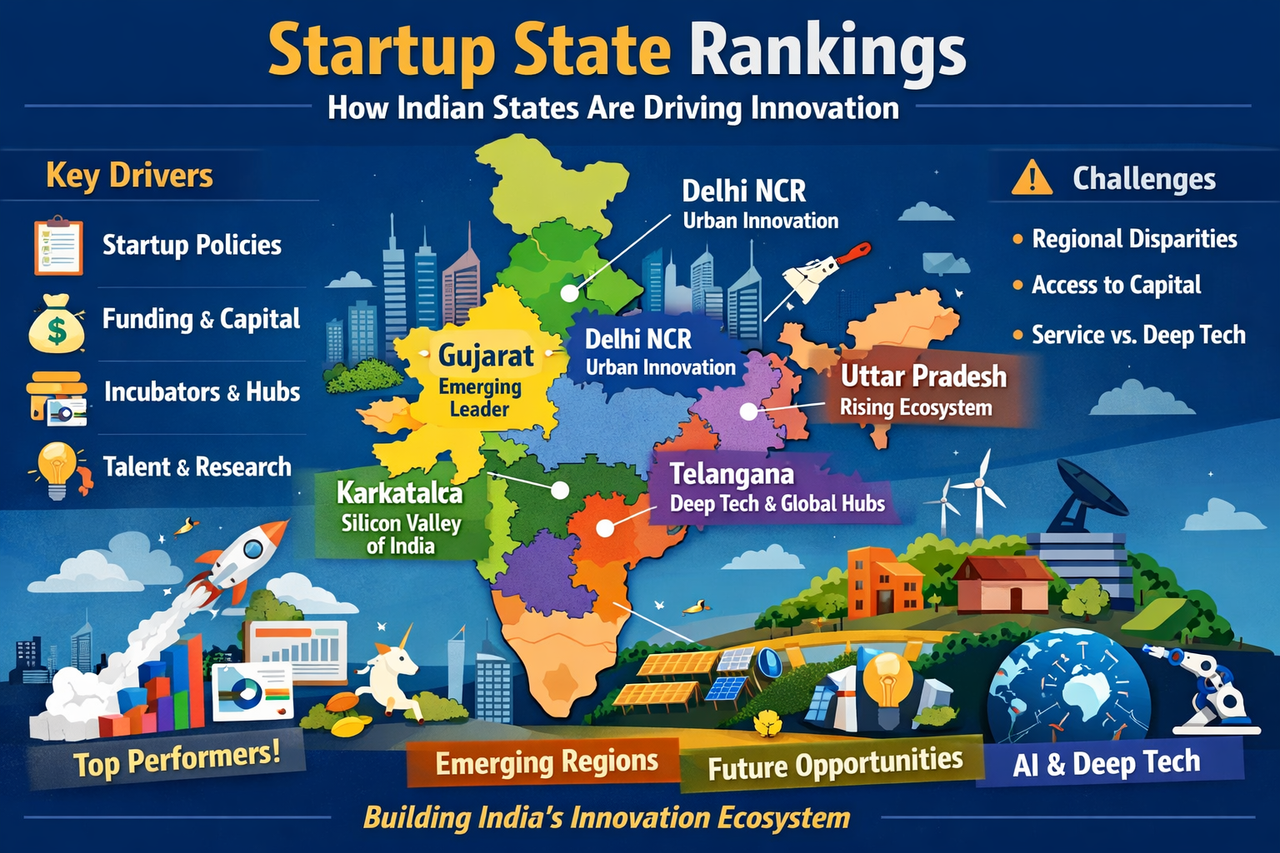
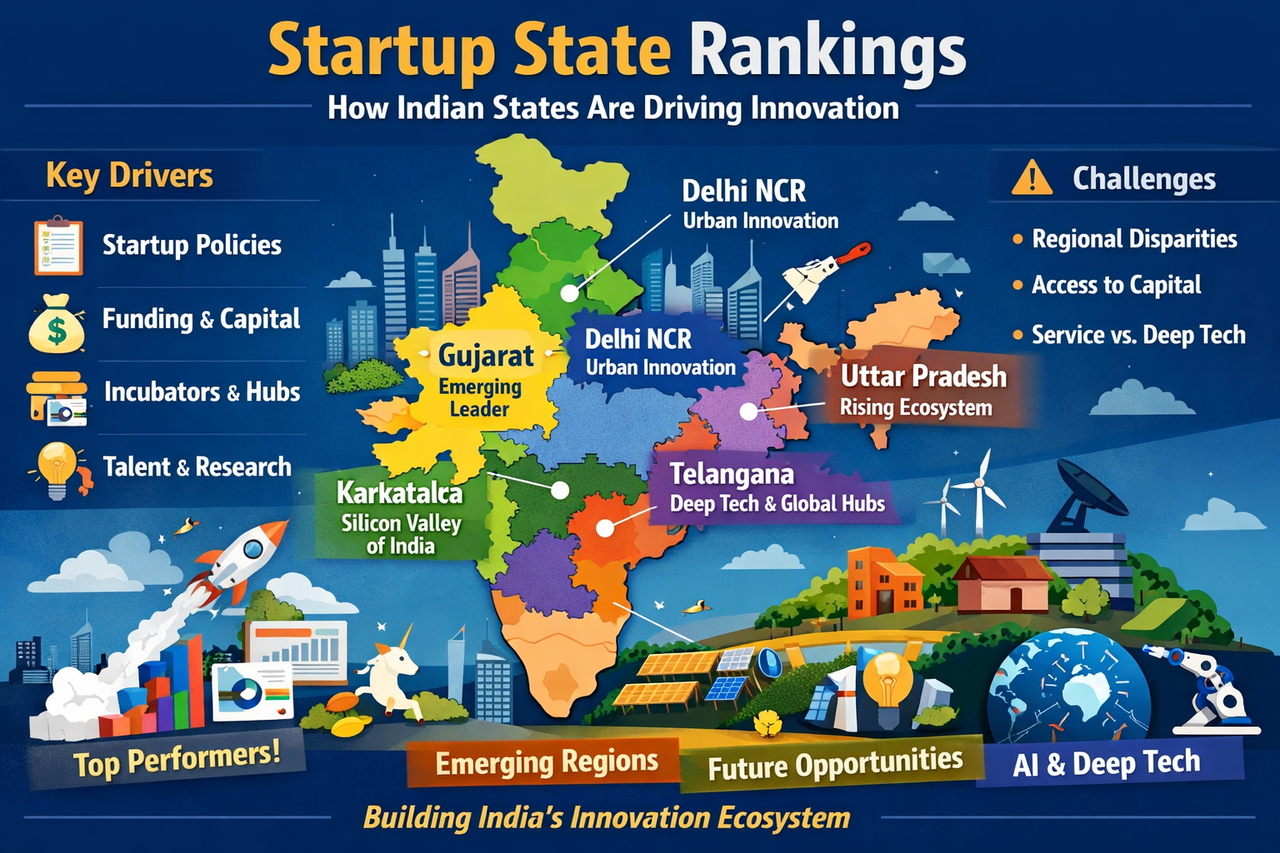
Startup growth remains uneven. While states like Karnataka and Maharashtra lead, many regions still struggle with limited funding, lack of mentors, and weak institutional support.
▸Focus on Service vs. Deep Tech
High numbers of startups do not always equate to high impact innovation. Many ventures are service‑oriented rather than deep tech or hardware based – limiting global competitiveness.
▸Access to Capital at Scale
While early‑stage funding is growing, access to larger growth capital and late‑stage investment remains concentrated in a few ecosystems.
6. The Road Ahead – Future Opportunities
The next phase of India’s startup evolution lies in several key trends:
▸Strengthening Tier‑2 & Tier‑3 Innovation Hubs
States like UP, Rajasthan, and Gujarat are extending ecosystem support beyond capitals to smaller cities diversifying the innovation base.
▸Integration of AI and Deep Tech
With startups increasingly focused on AI, clean energy, biotech, and advanced manufacturing, state policies are pivoting to these sectors promising higher‑value innovation outcomes.
▸Global Collaboration
Presence of global hubs (e.g., Google for Startups Hub in Telangana) bridges Indian founders with international mentors, capital, and markets.
▸Inclusive Entrepreneurship
Programs emphasizing women‑led startups (e.g., WEStart in Gujarat) and rural entrepreneurship (Tamil Nadu) point to a more inclusive innovation narrative.
India’s startup state rankings are more than a leaderboard, they reflect the diverse, multi‑layered approach required to cultivate vibrant innovation ecosystems. While traditional powerhouses like Karnataka and Maharashtra continue to dominate, increasingly dynamic ecosystems in Gujarat, Delhi NCR, Uttar Pradesh, and several emerging regions are reshaping how innovation is distributed across the country.
From targeted state policies and incubator networks to rural engagement and global partnerships, the Indian startup story is one of ecosystem evolution driven not just by numbers of startups, but by the quality of innovation, institutional support, and sustainable growth strategies being deployed at the state level.
As India sets its sights on higher global innovation rankings and deeper integration into global tech markets, the role of state‑driven innovation will be central to ensuring that entrepreneurial promise translates into economic impact, job creation, and technological leadership on the world stage.
Disclaimer: Curated from trusted sources; contact editorial@tice.news for corrections.