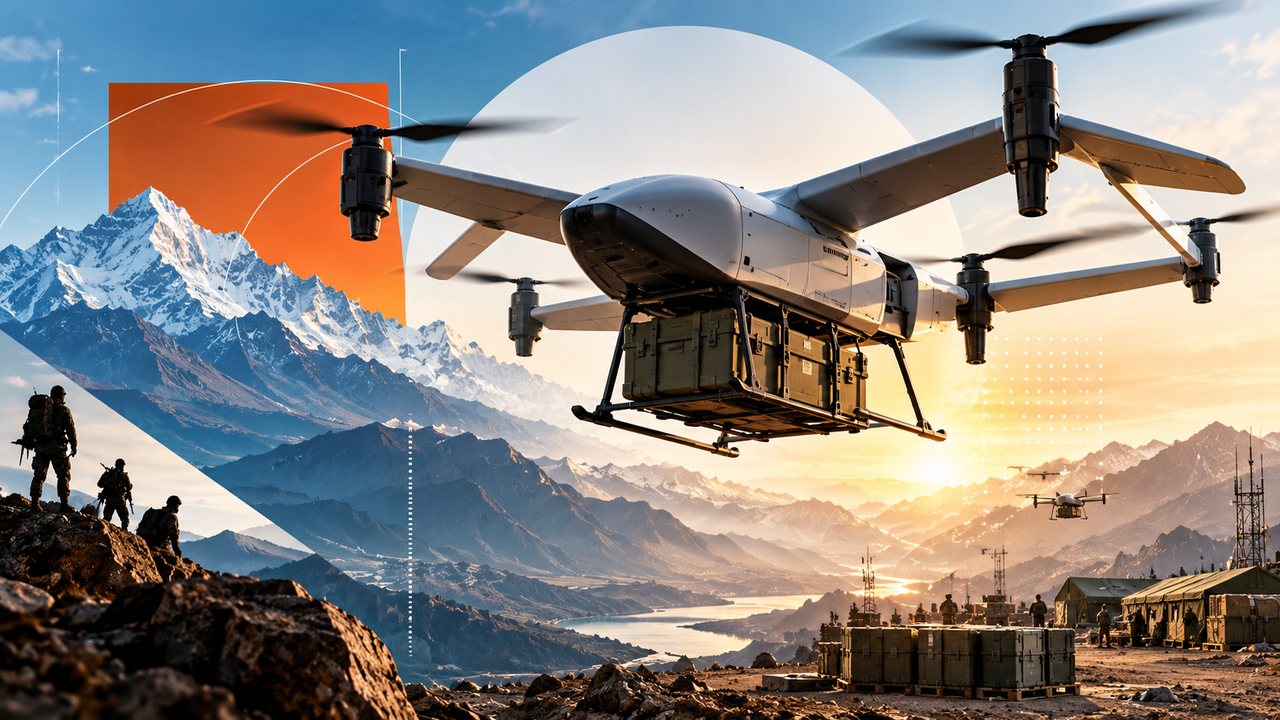

Mumbai-based ideaForge Technology has secured ₹151 crore in debt financing from the Technology Development Board (TDB), under the Department of Science and Technology, through the Research Development and Innovation (RDI) Fund to develop YETI, a heavy-lift autonomous aerial logistics vehicle.
The project has a total cost of ₹302 crore. The funding will support the development of a vertical take-off and landing, fixed-wing hybrid unmanned aerial vehicle designed to carry payloads of up to 200 kg over a targeted range of 200 km.
The programme aims to advance YETI from Technology Readiness Level (TRL) 4 to TRL 9 through further engineering, integration, testing and validation. These are development targets; the stated capabilities should not be read as confirmation of operational deployment.
RDI Fund Backs the Push Towards Deployment
The Research Development and Innovation (RDI) Fund support will be provided through debt financing, according to the project announcement. The programme falls under the deep-tech sector, with intelligent systems and robotics as its sub-sector.
The funding is intended to help ideaForge progress from technology development towards deployment, subject to technical, safety and regulatory requirements. For a heavy-lift autonomous aircraft, that journey involves validating propulsion, navigation, communications, payload handling and reliable operation in demanding environments.
YETI Targets the Gap Between Drones and Cargo Aircraft
YETI combines vertical take-off and landing (VTOL) with a fixed-wing configuration. The design aims to give the aircraft the flexibility to operate from small areas while retaining the range needed for longer journeys.
According to the project announcement, the aircraft is being designed to carry up to 200 kg of cargo, travel up to 200 km and operate at altitudes of up to 6,500 metres above mean sea level. It is intended to take off and land in areas measuring approximately 15 metres by 15 metres, including locations without prepared runways.
That combination could be relevant to military resupply, remote infrastructure operations and other logistics missions where building or maintaining conventional transport links is difficult.
The company’s proposed design also includes redundant propulsion and power systems, navigation in environments where Global Navigation Satellite System (GNSS) signals are unavailable, communications links of up to 200 km and swarm-operation capabilities. Containerised transport is intended to make the aircraft easier to move and deploy.
These are design specifications outlined for the programme. The announcement does not establish that YETI has demonstrated all these capabilities in operational conditions.

From Technology Development to Deployment
The funding will support further engineering, integration, testing and validation, with the programme aiming to advance YETI from TRL 4 to TRL 9, subject to technical, safety and regulatory requirements.
The distinction matters. Developing an aircraft that works under controlled conditions is different from proving that it can operate reliably across demanding environments. Heavy-lift autonomous aviation brings together several engineering challenges, including propulsion, flight control, payload stability, communications and navigation.
The aircraft must also perform consistently under changing weather and operating conditions. A logistics platform is useful only if it can deliver its payload reliably, return safely where required and operate within the applicable aviation and safety framework.
The project’s ₹302 crore cost reflects the scale of the development effort. TDB’s ₹151 crore contribution will be provided as debt financing rather than an equity investment, according to the announcement.
For ideaForge, the next milestones will be technical validation and progress towards the programme’s intended level of operational readiness.
Why Heavy-Lift Autonomous Logistics Matters
Drones have established roles in surveillance, mapping and inspection. Carrying substantial cargo over long distances introduces a different set of requirements, particularly when the destination is difficult to reach.
In high-altitude areas, for example, transporting supplies can involve challenging terrain and weather. Remote industrial sites, islands and other locations with limited infrastructure face their own logistical constraints. An aircraft that can carry useful payloads without requiring a conventional runway could offer an additional transport option.
But payload and range alone will not determine whether such a platform becomes commercially viable. Reliability, operating costs, maintenance, turnaround time and the ability to carry different types of cargo will influence adoption.
For defence applications, qualification and operational performance will be critical. Commercial logistics operators will also need to assess whether autonomous aerial transport can compete with existing methods on cost, speed and reliability.
The project therefore sits at the intersection of aerospace engineering and logistics. Its eventual market will depend on more than the aircraft’s technical specifications.
Government Funding Backs Indigenous DeepTech
TDB’s agreement with ideaForge falls under the Research Development and Innovation (RDI) Fund and is classified within deep technology, specifically intelligent systems and robotics.
TDB Secretary Rajesh Kumar Pathak said the board was supporting technology-intensive projects that require sustained investment to move from advanced development towards deployment. The agreement, he said, reflects the government’s effort to strengthen domestic capabilities in autonomous systems, robotics and aerospace technologies.
IdeaForge’s CEO and co-founder described YETI as an effort to develop an aircraft capable of delivering supplies in difficult operating conditions, including where roads end and weather complicates transport.
The government-backed financing gives the project resources to continue development. It does not, by itself, establish a delivery schedule, confirmed orders or commercial demand for the aircraft.
For India’s drone industry, the larger question is whether companies can move from developing individual platforms to delivering dependable systems that customers can operate repeatedly. That requires engineering, testing, production capability and a clear understanding of who will pay for the service.
YETI’s proposed combination of heavy payload capacity, long-range flight and vertical landing is designed to address a specific logistics problem. The next test is whether those capabilities can be demonstrated reliably outside the development environment—and whether customers find them valuable enough to deploy at scale.