Artificial Intelligence may be transforming the world at breakneck speed — but behind every AI breakthrough lies a silent crisis that few talk about openly: power.
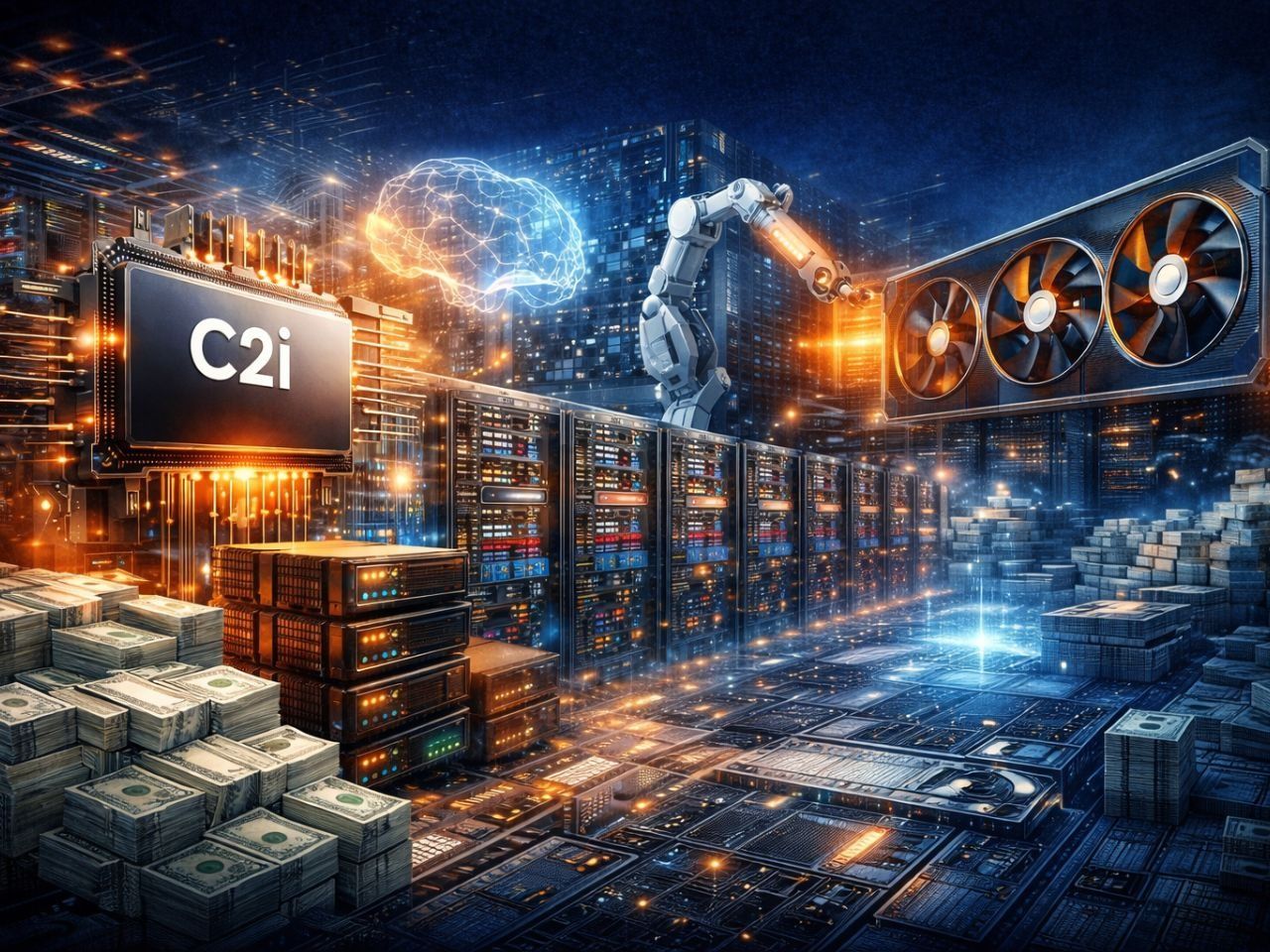
As AI models grow larger, smarter, and more compute-intensive, the pressure on data centres is mounting rapidly. GPUs are getting more powerful, servers are becoming denser, and hyperscale cloud infrastructure is expanding at unprecedented speed. Yet one fundamental challenge threatens to slow this momentum — efficient, scalable, and reliable power delivery.
Now, a Bengaluru-based semiconductor startup is stepping in to address that challenge head-on.
C2i Semiconductors has raised $15 million in a Series A funding round led by Peak XV Partners, with participation from Yali Deeptech and TDK Ventures, marking a significant milestone not just for the company but for India’s rapidly evolving deep-tech and semiconductor ecosystem.
Building the Backbone of AI Infrastructure
Founded in 2024 by Ram Anant, Vikram Gakhar, Preetam Tadeparthy and Dattatreya Suryanarayana, along with co-founders Harsha S. B and Muthusubramanian N. V, C2i Semiconductors is focused on one of the most critical layers of AI infrastructure — advanced power management solutions for next-generation AI data centres and cloud systems.
While AI companies compete to build faster models and hyperscalers race to deploy more GPUs, power delivery has quietly emerged as a bottleneck in modern data centre design. Legacy power architectures, originally designed for conventional computing loads, are increasingly struggling to handle the extreme power density demanded by AI workloads.
C2i’s mission is clear: rethink power delivery at a system level.
Instead of incremental improvements, the company is developing configurable, platform-based power architectures spanning from grid to core. The goal is to enable higher power density, simplify system design, and accelerate deployment for hyperscale AI infrastructure.
In simple terms, C2i wants to make sure that the AI revolution doesn’t stall because of inefficient power systems.
A Founding Team Built for Deep-Tech
One of the strongest pillars behind C2i is its founding team.
The company’s founders bring decades of experience in power and mixed-signal semiconductor platforms. They have previously worked with global industry leaders including Texas Instruments, National Semiconductor, Maxim Integrated, and Sanyo.
Collectively, the team has led the development of power technologies deployed across enterprise servers, AI infrastructure, mobile platforms, and automotive systems. Their work has resulted in hundreds of patents and products shipped at global scale.
This depth of expertise across hardware, silicon, and system design is particularly significant in an industry where credibility and execution capability often determine survival.
Why Power is AI’s Next Frontier
As AI workloads continue to expand, compute density inside data centres is rising dramatically. Advanced GPUs used for training and inference consume enormous amounts of power. The challenge isn’t just about generating more electricity — it’s about delivering it efficiently and reliably to where it is needed, without losses, instability, or heat management failures.
Power delivery is no longer a backend engineering detail. It is becoming central to AI infrastructure economics.
Commenting on the fundraise, Ram Anant, Co-Founder and CEO of C2i Semiconductors, said AI is fundamentally reshaping how data centres are designed, with power delivery emerging as a critical constraint in scaling infrastructure.
He noted that the fresh capital will help accelerate the development of next-generation, high-density, ultra-reliable system-level power platforms.
Anant also acknowledged the support of the Ministry of Electronics and Information Technology (MeitY) under the Design Linked Incentive (DLI) scheme, which helped the company transition from early silicon concepts to market-ready solutions — an important validation for India’s semiconductor design push.
Investor Confidence in India’s Semiconductor Moment
For investors, C2i represents more than a single company — it reflects a broader shift.
Rajan Anandan, Managing Director at Peak XV Partners, highlighted that power has become a major bottleneck in scaling AI infrastructure. He pointed to C2i’s world-class founding team and their deep expertise across hardware, silicon, and system architecture as a key differentiator.
He added that C2i’s approach to power management has the potential to significantly extend GPU longevity and unlock billions of dollars in cost savings for the industry — a strong endorsement in an ecosystem where efficiency directly translates into massive capital savings.
Importantly, Anandan expressed confidence in the startup’s ambition to build a global semiconductor company from India — a statement that aligns closely with the country’s growing aspirations in chip design and advanced electronics.
The 5S AI Vision
C2i’s long-term ambition goes beyond power modules.
The company aims to become a trusted technology partner powering some of the world’s most critical computing infrastructure. Its roadmap is aligned with what it calls the “5S AI” vision — building AI systems that are:
-
Sustainable
-
Safe and Secure
-
Scalable
-
Self-improving
-
Sovereign
In an era where AI is increasingly intertwined with national strategy, digital infrastructure, and enterprise competitiveness, resilient and efficient power systems are foundational to responsible AI deployment.
A Signal for India’s Deep-Tech Ecosystem
The $15 million Series A funding underscores growing investor confidence in India’s semiconductor and deep-tech startup ecosystem.
Over the past few years, India has accelerated efforts to build indigenous capabilities in chip design, AI infrastructure, and next-generation computing technologies. Government initiatives like the DLI scheme, coupled with rising venture capital interest in hard-tech startups, are gradually reshaping the country’s innovation landscape.
C2i Semiconductors sits at the intersection of these forces — AI growth, semiconductor design capability, and infrastructure-scale innovation.
As global AI demand surges, the race is not only about building smarter algorithms. It is about building the physical systems that make them possible.
And increasingly, those systems may be designed in India.
Disclaimer: This press release has been provided by the corporate communication/PR team of the respective organization. TICE neither verifies nor endorses the claims made and shall not be held responsible for their accuracy. The content may have been edited for style or clarity without altering the facts as provided. Any business or financial decision made on the basis of this content is at the reader’s sole discretion and risk. For any dispute regarding this content, please contact editorial@tice.news.