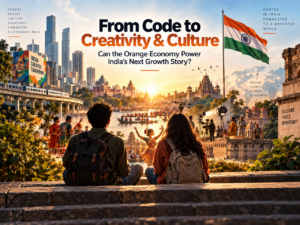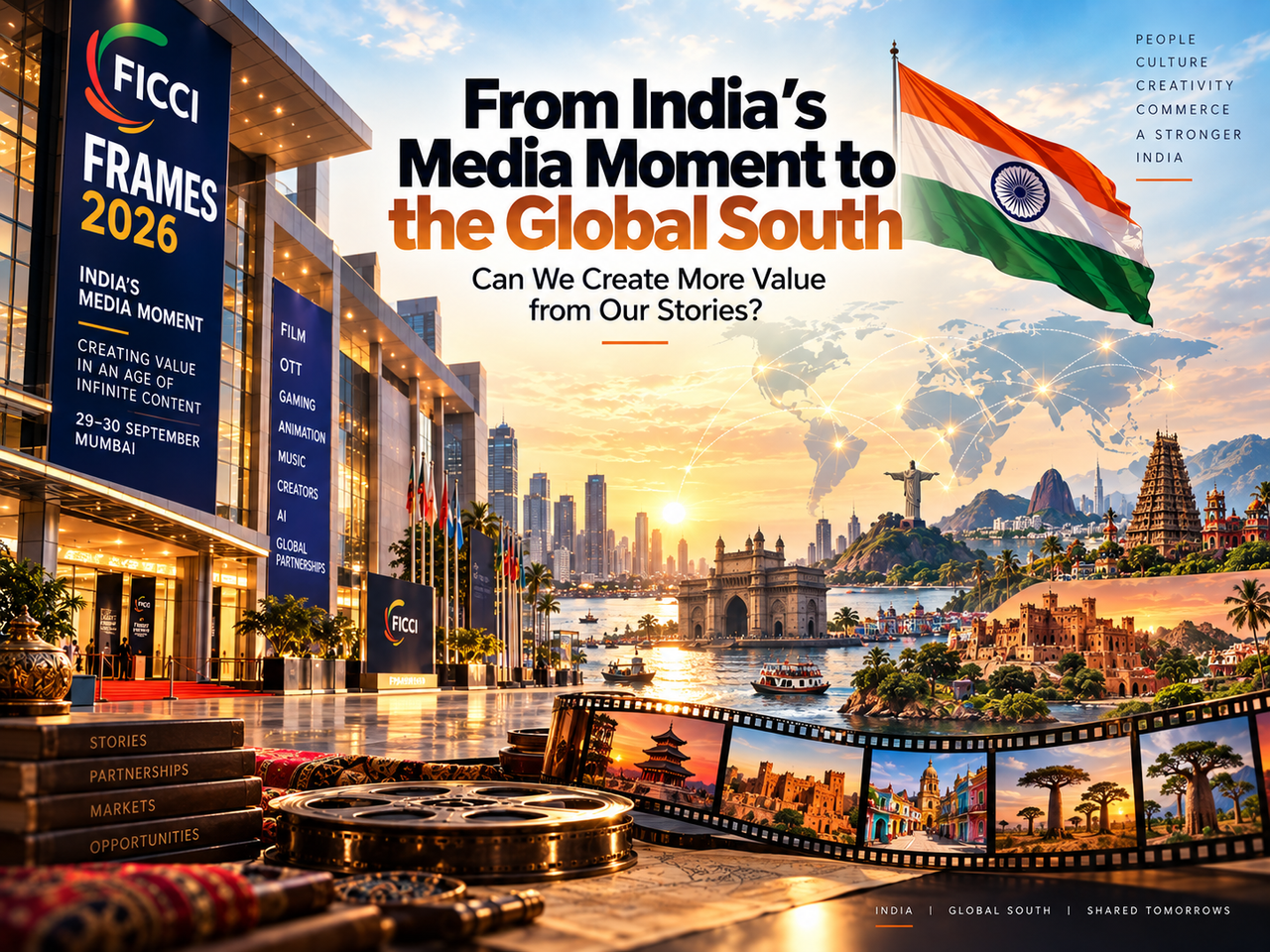

As FICCI FRAMES 2026 brings India’s media and entertainment industry together around the question of creating value in an age of infinite content, Dr Seema Narera asks a larger question: Can India turn its storytelling strength into deeper global partnerships across the Global South?
What Happens When Content Is No Longer the Scarce Resource?
The media and entertainment industry has moved rapidly from a world of limited content to one of almost unlimited content. Films, series, short-form video, podcasts, gaming, animation, music, creator-led formats and now AI-generated content are multiplying at extraordinary speed. The question is no longer simply whether we can create enough content.
The more important question is: How do we create lasting value from it?
That is why I am particularly interested in the theme of FICCI FRAMES 2026 “India’s Media Moment: Creating Value in an Age of Infinite Content.” The 26th edition takes place in Mumbai on September 29-30, 2026 bringing together stakeholders from across India’s media and entertainment ecosystem.
“For me, this conversation comes at an important moment. Because India’s media opportunity should not end with producing more content.”
Can India Turn Its Media Moment into a Global Moment?
India has one of the world’s most diverse storytelling ecosystems.
We tell stories in hundreds of languages. We have cinema industries across regions, enormous television and OTT audiences, music traditions, animation and VFX talent, gaming and creator communities, and a cultural archive that stretches across thousands of years.
But there is another opportunity we should discuss more seriously.
Can India become not only a major producer of stories, but also a connector of stories?
Can Mumbai and other Indian creative centres become meeting points between Indian creators and the creative industries of Africa, Latin America, the Middle East, Southeast Asia ?
That would take the conversation from content to connections, markets and partnerships.
What If the Next Opportunity Is Not More Content, But More Connections?
FICCI FRAMES has evolved into an important platform for dialogue, networking and business engagement across the media and entertainment industry. Its own positioning has increasingly looked beyond the Indian market towards global collaboration and expansion.
I see a natural next question emerging from that ecosystem.
Once creators meet, what happens next?
-Can they co-produce, co-finance?
-Can a story from Brazil find a producer in India?
-Can an Indian animation studio work with a company in Africa ?
-Can a filmmaker from Kazakhstan discover Indian distribution partners?
-Can African, Latin American and Asian stories find financing, technology and audiences through India?
These are not only cultural questions. They are business questions.
Why Should a Global South Story Have to Travel North ?
This question has stayed with me while building the Global South Film Festival with our international consortium.
The Global South is not one market. It is an extraordinarily diverse network of cultures, languages, economies, audiences, filmmakers, producers, investors and creative enterprises. Yet the pathways between these regions are often not as direct as they could be.
That is a gap worth addressing. Not by closing existing global doors. But by opening more doors in more directions.
What Could India’s Role Be?
I believe India can become one of those meeting points as demonstrated during India’s G20 presidency in 2023 & BRICS chairship in 2026. Though these were Government of India led, the industry and people played a pivotal role in its success.
We have the scale of a huge domestic market. We have established film and entertainment infrastructure, production talent, digital platforms and increasingly sophisticated creative technology.
We also have cultural familiarity with many parts of the Global South. India can therefore play a role that goes beyond being a content producer.
It can become a creative marketplace and bridge.
The opportunity is not simply to sell a film. It is to create everything that can happen around the story like co-production, distribution, tourism, technology, talent, investment, intellectual property and new businesses.
Can Cinema Become Infrastructure for Cultural Exchange?
Cinema has one extraordinary advantage. It gives people a reason to meet.
A film can introduce us to another country. A story can create curiosity about a culture. A character can make a place familiar. A festival can bring the people behind those stories into the same room.
And once people meet, other conversations become possible.
Co-production. Distribution. Tourism. Investment. Technology. Talent. Education.
This is part of the thinking behind Global South Film Festival.
We are building a travelling international film platform around Women, Stories and Capital, while connecting cinema with markets, co-production, talent development and cultural exchange.
The ambition is not to create another gatekeeper. It is to create more bridges.
What Would Happen If Stories Became Business Bridges?
Imagine a producer meeting a filmmaker from another country. That conversation becomes a co-production.
The co-production creates employment in two countries. A location becomes a destination. A soundtrack creates a new audience. A local craft enters the production. A streaming platform discovers a new market. An investor enters the ecosystem.
Suddenly, cinema is no longer only an end product. It has become economic infrastructure for relationships.
That is the opportunity I see.
How can that value travel further and how can India become a bridge for creative value moving in both directions across the Global South?
Could India’s Media Moment Become a Global South Creative Moment?
I am going to FICCI FRAMES this week with these questions in my mind.
I want to listen to what creators, producers, technology companies, investors and industry leaders are saying about the future of content and the business around it.
And perhaps the most interesting conversations will be the ones that happen outside the formal sessions.
Because India’s next media opportunity may not simply be about creating more content. It may be about creating more connections around that content.
-From India to the Global South.
-From content to collaboration.
-From audiences to markets.
-From screening stories to building relationships around them.
Perhaps India’s real media moment is not simply about becoming a bigger content producer. It is about becoming one of the places where the world’s stories meet.
That is the conversation I hope to carry from FICCI FRAMES to GSFF and, importantly, bring back with me after FICCI FRAMES.