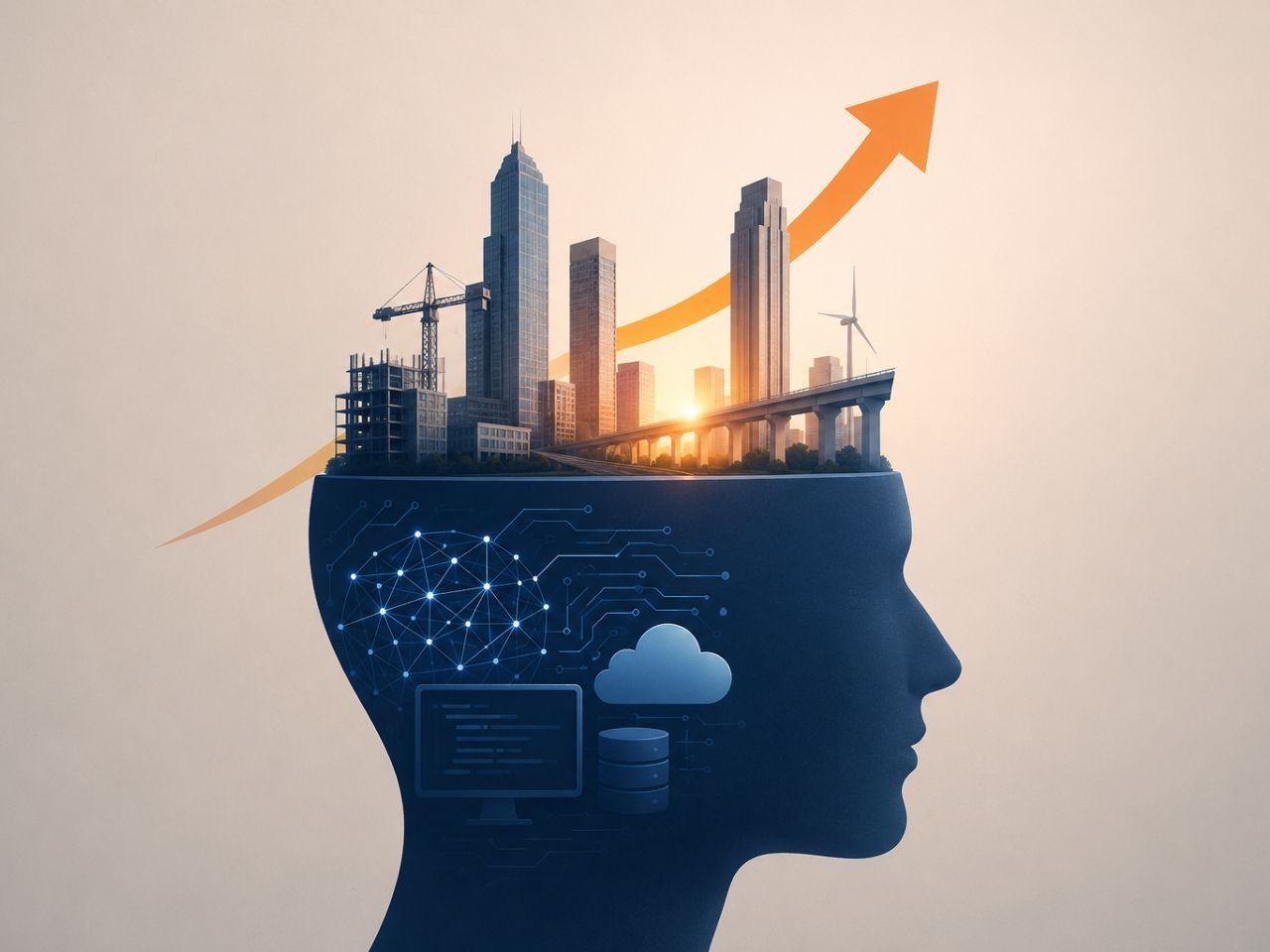

India’s economic transformation is usually visible in concrete and steel.
New highways cutting across states, airports coming up in smaller cities, factories expanding production capacity, warehouses following the rise of ecommerce, semiconductor projects taking shape, and billions of dollars flowing into physical infrastructure.
But another transformation is unfolding quietly alongside it.
It cannot be seen from a highway, photographed at an industrial park or measured by counting the number of factories being built. It resides inside the software developed by companies, the databases accumulated by digital businesses, the research undertaken by enterprises, the brands created by entrepreneurs and the organisational capabilities that allow companies to grow.
This is the world of intangible investment. And India is emerging as one of its fastest-growing players.
According to the World Intangible Investment Highlights 2026, published by the World Intellectual Property Organization (WIPO) and Luiss Business School, India recorded 7.9% year-on-year real growth in intangible investment in 2022–23 — the fastest among the 15 largest economies covered by the report.
India was followed by Japan at 4.8%, the Philippines at 4.6% and the United States at 4.4%, although the latest available years differ across economies. India’s growth figure pertains to 2022–23, Japan’s to 2023–24, the Philippines’ to 2021–22, while the US figure reflects 2024–25.
The finding becomes more significant when placed within the larger transformation taking place across the global economy.
Intangible investment across the 29 economies covered by the study exceeded $10 trillion in 2025. Since 2008, investment in intangible assets has grown more than three times faster than investment in physical assets such as machinery, buildings and equipment.
Economic value, in other words, is increasingly being created by assets that cannot necessarily be seen or touched.
And India appears to be accelerating into this transition.
What Is India Actually Investing In?
To understand the significance of India’s rise, it is important to understand what economists mean when they talk about intangible investment.
Consider a software company that spends years developing a technology platform. A pharmaceutical company conducting research on a new drug. A consumer startup investing in its brand and distribution systems. A logistics company building proprietary software to optimise deliveries. Or an artificial intelligence startup developing algorithms and accumulating specialised datasets.
None of these investments necessarily results in the creation of a factory or a machine.
Yet they can become some of the most valuable assets a company owns.
The WIPO-Luiss framework includes software and databases, research and development, brands, design, organisational capital, employer-provided training, new financial products and other intellectual property products within the intangible economy.
The growing importance of these assets reflects a fundamental change in how businesses compete.
An automobile company may still require factories, machinery and supply chains, but an increasing share of its competitive advantage can come from software, battery technology, product design, patents, data and brand value.
For technology companies, the shift is even more pronounced. Their most important assets may consist almost entirely of software, intellectual property, customer networks, data and organisational knowledge.
India’s economic structure makes it particularly well positioned for this transition.
Software Is Powering India’s Intangible Investment Boom
The most striking finding about India is not simply that intangible investment is growing rapidly. It is the composition of that investment.
Software and databases accounted for nearly 45% of India’s total intangible investment in 2023 — the highest share among all the economies covered by the report.
The comparison with other major economies is revealing.
Software and databases accounted for 17.3% of intangible investment in the United States, 23.1% in France and only 8.2% in Germany.
India’s concentration in software reflects an economic capability built over several decades.
The country’s information technology industry created a large pool of technical talent and helped India become one of the world’s largest exporters of software services. That foundation has subsequently supported the growth of enterprise technology companies, SaaS startups, fintech platforms, ecommerce businesses and an increasingly diverse digital economy.
Software is also no longer confined to the technology industry.
Banks are investing in digital platforms and fraud-detection systems. Manufacturers are deploying automation and data analytics. Retail companies are building digital supply chains. Logistics companies are developing proprietary technology to manage transportation networks.
Across sectors, software and data are becoming part of the basic infrastructure of doing business.
The report estimates that investment in software and databases in India grew at an annual rate of 8.2% between 2013 and 2023.
This raises an important question for the Indian economy.
Is the country’s long-established advantage in software services gradually evolving into something larger — an economy increasingly capable of creating value through digital products, proprietary technology, data and intellectual property?
For India’s startup ecosystem, the answer could have far-reaching consequences.
India Is Building Two Economies at the Same Time
India’s rise in intangible investment is particularly interesting because it is not happening at the expense of physical investment.
In several advanced economies, the growth of intangible investment has coincided with slowing or declining investment in physical assets.
Japan is one example. Since 2019, tangible investment has declined below its 2015 level while intangible investment has continued to expand. Germany and Canada show similar shifts towards knowledge-based assets.
India’s trajectory is very different.
The country remains one of the most tangible-investment-intensive economies covered by the report. Tangible investment represented around 19.3% of India’s formal-sector GDP in 2023, compared with 10% for intangible investment.
Between 2013 and 2023, India’s intangible investment grew at an annual rate of 5.3%. Physical investment expanded even faster, at 7.8%.
This means India is effectively building two economies simultaneously.
The first is the physical economy required by a developing country of 1.4 billion people — roads, railways, factories, airports, energy infrastructure, logistics networks and urban capacity.
The second is the knowledge economy required to compete in a world increasingly driven by technology — software, data, research, intellectual property, brands and organisational capabilities.
Many advanced economies built their industrial infrastructure first and gradually shifted towards knowledge-intensive investment as they became richer.
India is attempting both transformations at once.
That combination could become one of the defining characteristics of the country’s economic development over the next decade.
Startups Are Part of the Invisible Investment Story
The report does not attempt to quantify how much of India’s intangible investment growth comes directly from startups. Yet the rise of the country’s technology and entrepreneurial ecosystem forms an important part of the broader transformation.
Modern startups are, by their nature, highly dependent on intangible assets.
A SaaS startup can spend years developing software before generating meaningful revenues. A fintech company invests in technology infrastructure, risk models and consumer trust. A deeptech startup may spend years building intellectual property and research capabilities before commercialising a product.
Even consumer startups that sell physical products increasingly derive their competitive advantage from brand recognition, digital distribution, customer data and supply-chain systems.
This makes the rise of intangible investment particularly relevant for understanding India’s startup economy.
Traditional measures of investment were designed for an industrial economy in which businesses accumulated machinery, factories and equipment.
But many of today’s fastest-growing companies accumulate a very different set of assets.
Their value lies in code written over several years, proprietary databases, technological capabilities, brands, research and internal systems that allow companies to scale.
Some of these assets are recorded in official economic statistics.
Many are not.
The report estimates that around 62% of global intangible investment remains unmeasured in official statistics because assets such as organisational capital, design, market research and brands are generally not treated as investment in national accounts.
This creates a larger question for economies such as India, where digital businesses and technology startups are becoming increasingly important.
Are conventional economic statistics fully capturing the investment taking place inside the modern economy?
But India’s Intangible Economy Has a Weak Spot
India’s software advantage is significant, but the composition of its intangible investment also exposes an important vulnerability.
Research and development accounted for only 12.7% of India’s intangible investment in 2023.
The corresponding share was 33.5% in Japan, 30.8% in Germany and 22.7% in the United States.
The difference matters.
Software adoption can increase productivity and create valuable businesses, but sustained technological leadership depends on the ability to conduct research, create intellectual property and commercialise new technologies.
India has built a large software industry and one of the world’s biggest technology talent pools. The next challenge is whether the country can convert these capabilities into deeper technological ownership.
Can India produce more globally competitive intellectual property? Can its startups move from applying existing technologies to creating fundamental technologies? Can the country build stronger research capabilities in artificial intelligence, semiconductors, biotechnology, advanced materials and climate technology?
These questions will increasingly shape the next phase of India’s innovation economy.
The government’s push towards deeptech, domestic manufacturing and research-led innovation is partly an attempt to address this gap. But India’s intangible investment profile suggests that the transition from a software-driven economy to a broader innovation-driven economy is still a work in progress.
AI Could Accelerate India’s Next Intangible Investment Wave
Artificial intelligence could make this transition even more consequential.
The first phase of the global AI investment boom has largely been physical.
Technology companies are spending enormous amounts of capital on data centres, semiconductors, computing infrastructure and the energy systems required to power AI models.
But the report argues that the longer-term economic impact of AI could emerge through another, slower wave of investment.
As companies adopt AI, they will have to reorganise themselves around the technology.
Businesses will need better data systems, new software, redesigned workflows, AI-enabled research capabilities and employees capable of working with increasingly sophisticated technologies.
In other words, AI could accelerate investment across the entire intangible economy.
For India, this creates both an opportunity and a challenge.
The country’s existing software capabilities provide a strong foundation for AI adoption. But simply using AI tools will not necessarily create long-term economic advantage.
The more important question is whether Indian companies can build proprietary datasets, create original technologies, redesign organisations around AI and develop intellectual property that can compete globally.
The countries and companies that capture the greatest economic value from AI may not necessarily be those that use the most AI applications.
They may be those that build the strongest intangible assets around them.
India Is Growing Fast, But the Gap Remains Huge
Despite leading recent intangible investment growth, India remains far behind the world’s largest intangible economies in absolute terms.
India’s intangible investment stood at approximately $78 billion in purchasing power parity terms in 2023. This was higher than several European economies, including Denmark, the Czech Republic and Finland.
But the United States invested nearly $5 trillion in intangible assets in 2025.
Japan recorded approximately $810 billion in 2024, while Germany’s intangible investment stood at around $695 billion.
The comparison illustrates the scale of India’s opportunity.
High growth rates are important, particularly for an economy attempting to expand its technological capabilities.
But growth from a relatively smaller base will not automatically translate into global leadership.
India will need to deepen its investment beyond software and databases. Stronger research capabilities, more intellectual property creation, globally competitive brands, better design capabilities and companies capable of commercialising innovation will become increasingly important.
The real measure of progress will not simply be how much intangible investment India attracts or creates.
It will be how much of the resulting economic value Indian companies are able to own.
The Next Chapter of India’s Growth Story May Be Harder to See
India’s rise is usually narrated through numbers that are easy to understand.
GDP growth, infrastructure spending, manufacturing output, foreign investment, exports and startup funding.
But the expansion of intangible investment reveals another dimension of the country’s economic transformation.
India is still building the physical foundations of a modern economy.
At the same time, companies are accumulating software, data, intellectual property, research capabilities, brands and organisational knowledge.
One transformation is visible across the country’s landscape.
The other exists largely inside companies.
India’s emergence as the fastest-growing major economy for intangible investment suggests that the second transformation is gathering pace.
But the next phase will be more difficult.
India has already demonstrated its ability to build software capabilities and digital businesses. The challenge now is to turn those capabilities into deeper research, globally valuable intellectual property, powerful brands and technologies that Indian companies can own and commercialise at scale.
Because in an economy increasingly shaped by AI, software and knowledge, the countries that create the most value may not necessarily be those that build the most physical assets.
They may be the ones that learn how to own what cannot be seen.