
There’s something quietly transformative about financial institutions moving closer to where businesses actually exist. Not in boardrooms of metros, but in the lanes of emerging industrial cities, where ambition often outpaces access. And in Raipur this week, that gap just got a little smaller.
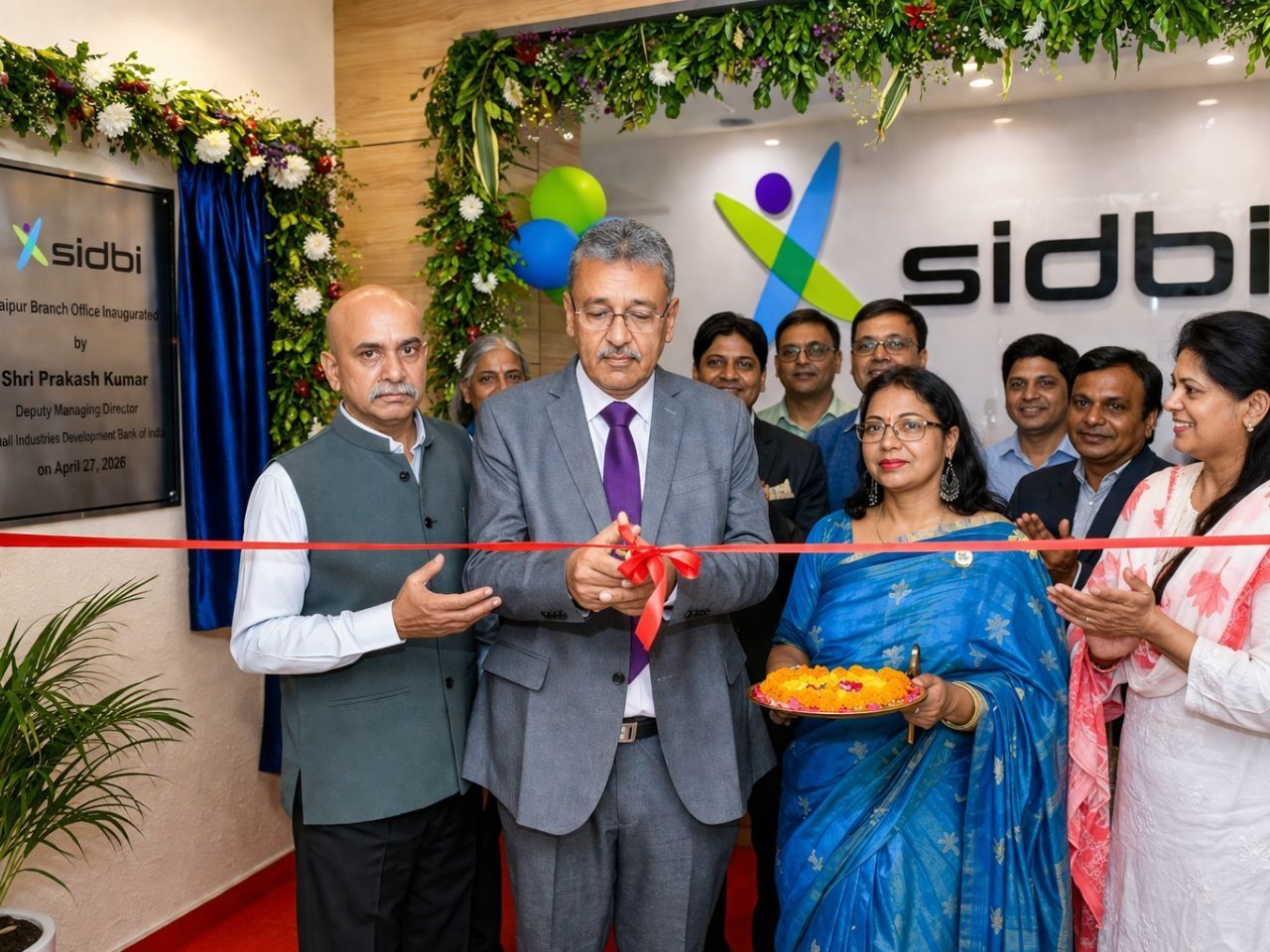
In a significant step towards strengthening India’s grassroots entrepreneurial ecosystem, Small Industries Development Bank of India (SIDBI) has expanded its on-ground presence with the inauguration of a new, state-of-the-art branch office in Raipur. The move is more than just a real estate addition—it signals a deeper, more deliberate push to bring credit, support, and opportunity closer to startups and MSMEs operating beyond the usual startup hotspots.
Located at the LIC Building in Pandri, the new office was inaugurated by Prakash Kumar, alongside senior officials, industry leaders, customers, and key stakeholders. But beyond the ceremony, the message was clear: SIDBI is doubling down on regional India.
Building access where it matters most
For years, one of the biggest hurdles for small businesses—especially in emerging states like Chhattisgarh—has been access. Not just to capital, but to the right kind of financial guidance, networks, and institutional backing. SIDBI’s new Raipur office is designed to address exactly that.
Speaking at the event, Prakash Kumar underlined how the new branch is expected to function as a critical hub for MSME growth in the region. With upgraded infrastructure and stronger operational capabilities, the office is positioned to respond faster and more effectively to the evolving needs of entrepreneurs—from first-time founders to scaling small businesses.
And that responsiveness could make all the difference. In regions where businesses often struggle with delayed financing or limited institutional touchpoints, proximity isn’t just convenience—it’s opportunity.
A two-way conversation with industry
Interestingly, the inauguration wasn’t just about announcements. It also opened the floor to something equally important: listening.
A dedicated customer interaction session brought together MSME representatives, entrepreneurs, and industry associations in direct conversation with SIDBI officials. These interactions revealed a strong appreciation for SIDBI’s increasingly streamlined loan processing systems and its proactive stance on addressing financing gaps—particularly for small enterprises and first-generation entrepreneurs who often find themselves navigating complex financial systems for the first time.
The presence of senior leaders like Yashwanth Narain Kulkarni and Santosh Rao More further underscored the institution’s intent to stay closely connected with ground realities, not just policy frameworks.
Partnerships as a growth multiplier
If there was one clear takeaway from the event, it was this: SIDBI isn’t looking to operate in isolation.
Representatives from key industry bodies, including the Urla Industries Association and the Chhattisgarh Federation of Industries, were present—highlighting the growing importance of collaborative ecosystems in driving MSME growth.
Going forward, SIDBI has encouraged the Raipur branch to actively explore Memoranda of Understanding (MoUs) with such associations under its PROMO schemes. These partnerships are expected to play a crucial role in improving last-mile connectivity, ensuring smoother credit flow, and supporting capacity-building initiatives for businesses across sectors.
In simpler terms: the idea is to meet entrepreneurs where they already are—and strengthen the systems around them.
A larger national play
This expansion in Raipur isn’t an isolated move. It fits into SIDBI’s broader strategy of positioning itself as a key enabler of India’s startup and MSME ecosystem.
Since its establishment in 1990, SIDBI has steadily built its role as a development financial institution focused on promoting, financing, and nurturing MSMEs. Its approach has evolved over time—from direct lending and indirect credit support to a more holistic model that includes developmental initiatives, ecosystem partnerships, and startup-focused programs.
The Raipur office adds another important node to this network.
What this means for the ecosystem
For Chhattisgarh, this could be a turning point. The state has long held industrial potential, but access to structured financial support has often lagged behind more mature ecosystems.
With SIDBI strengthening its presence on the ground, businesses in the region—whether traditional MSMEs or new-age startups—stand to benefit from easier access to credit, stronger institutional backing, and more consistent engagement.
And at a broader level, moves like this contribute to something much larger: decentralising India’s startup story.
Because the next wave of innovation and enterprise isn’t just coming from metros—it’s emerging from cities like Raipur, where ambition is high, but support systems are still catching up.
SIDBI’s latest expansion suggests that gap is now firmly in focus.