At a summit meant to showcase India’s artificial intelligence ambitions to the world, one university stall unexpectedly became the centre of controversy.
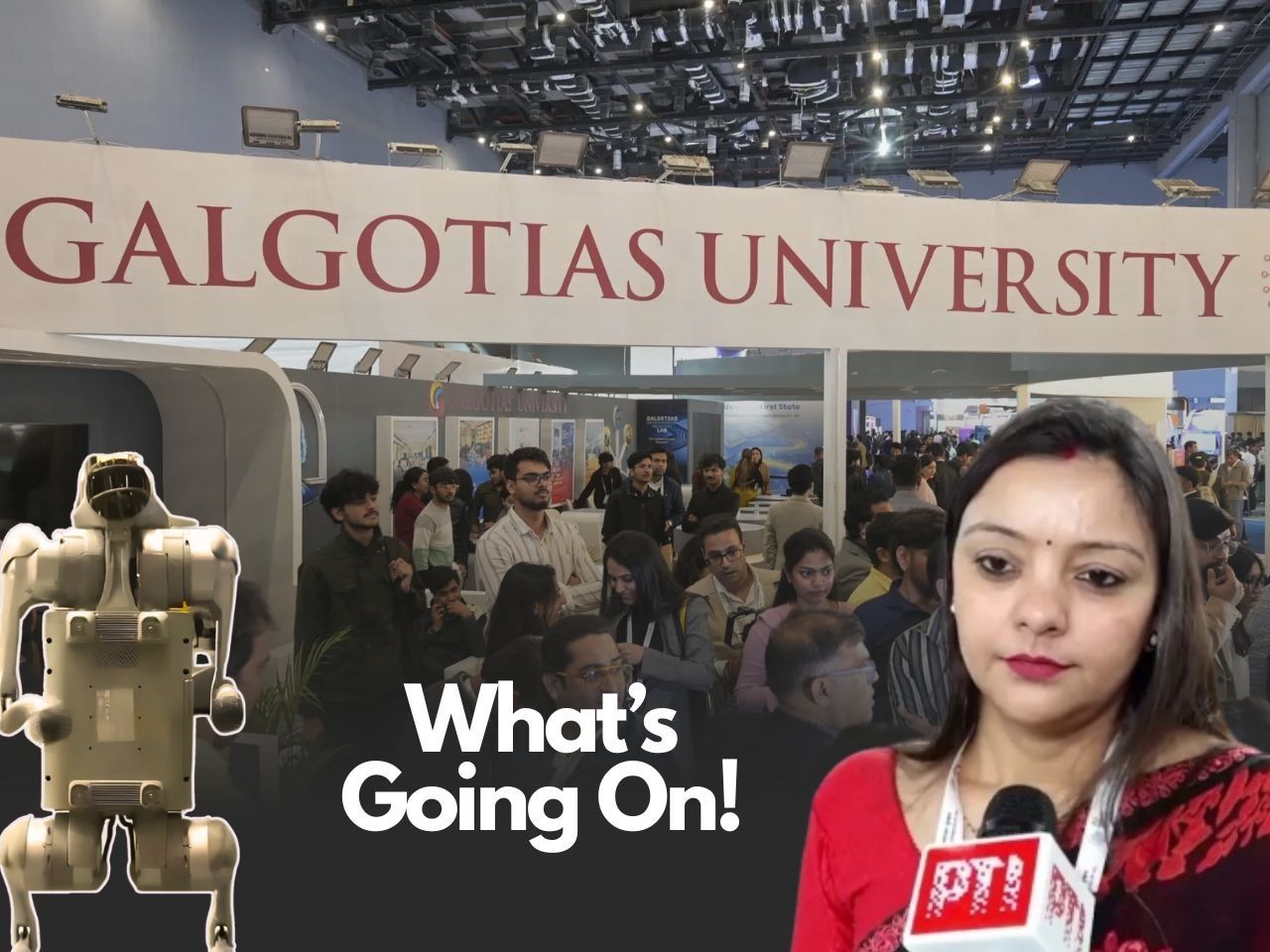
Galgotias University was asked to vacate its exhibition space at the India AI Impact Summit in New Delhi after a robotic dog displayed at its kiosk was presented as an in-house innovation — only for it to be identified online as a commercially available Chinese product.
Here’s what happened.
Galgotias Controversy at India AI Summit
The Robot That Triggered the Debate
During coverage at the summit, a Galgotias faculty member introduced a robotic dog named “Orion,” stating it had been developed by the university’s Centre of Excellence.
But within hours, social media users pointed out that the robot appeared to be the Unitree Go2, a robotic dog manufactured by China-based Unitree Robotics and widely available globally for research and educational use at a price of around $2,800.
The clip went viral.
Two government sources later told Reuters that the university was asked to vacate its stall following the controversy. However, as of midweek, the stall remained open, and university representatives said they had not received formal communication about removal.
The Minister’s Deleted Post
The issue gained further traction after Union IT Minister Ashwini Vaishnaw briefly shared the video clip on social media. The post was later deleted as online criticism mounted.
Soon after, both the faculty member and the university clarified that the robot was not developed by Galgotias and that the university had not formally claimed it as an original invention.
Still, the damage had already been done.
Why This Became Bigger Than a Stall
The incident occurred at a high-stakes moment.
The India AI Impact Summit, being held at Bharat Mandapam in New Delhi, has been positioned as a major AI gathering for the Global South. Prime Minister Narendra Modi, Google CEO Sundar Pichai, OpenAI CEO Sam Altman and Anthropic CEO Dario Amodei are among the global tech leaders addressing the event.
More than $100 billion in AI-related investments — spanning data centres, infrastructure, and ecosystem development — have been pledged during the summit, including commitments from the Adani Group, Microsoft and Yotta.
Against that backdrop, a question naturally emerged: At a time when India is positioning itself as a serious AI powerhouse, how careful must institutions be about claims of innovation?
Optics in the Age of AI
In today’s AI race, credibility matters as much as capital.
Universities and startups routinely use globally available hardware platforms for research and demonstration. That, in itself, is common practice. The controversy arose not from displaying the robot — but from how it was framed.
For a summit intended to project India’s technological depth to global investors and leaders, even a single instance of misrepresentation — intentional or not — can quickly spiral in the age of viral video.
Opposition leaders also criticised the episode, arguing it reflected poorly on India’s AI positioning.
The Larger Context
Beyond the controversy, the summit has highlighted India’s accelerating AI push — from infrastructure buildout to enterprise adoption and global partnerships.
But the Galgotias episode underscores something equally important: in a globally watched AI ecosystem, transparency and clarity are non-negotiable.
For India’s universities, startups and institutions, the takeaway is simple — in the AI era, claims travel fast. And scrutiny travels faster.