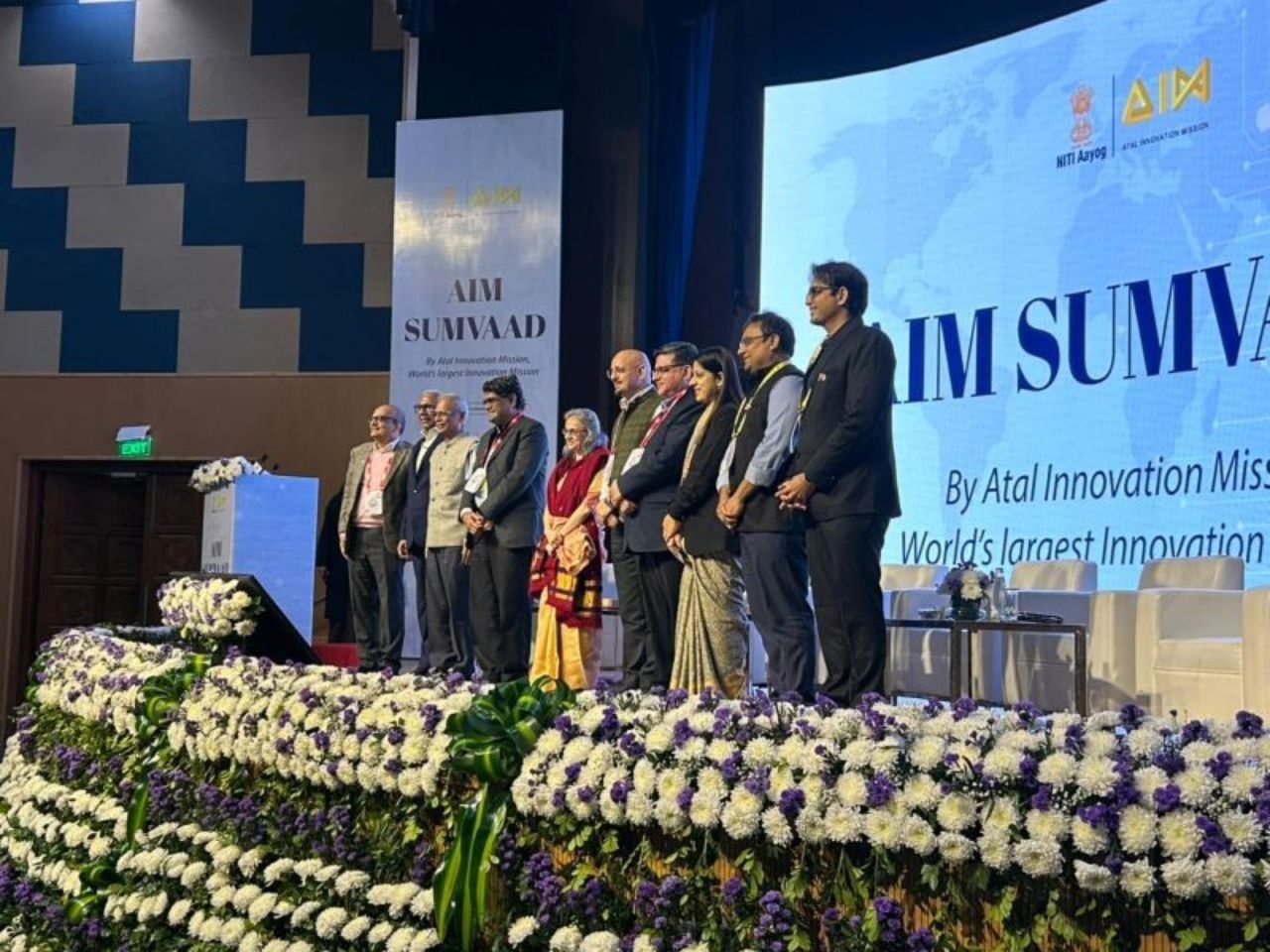
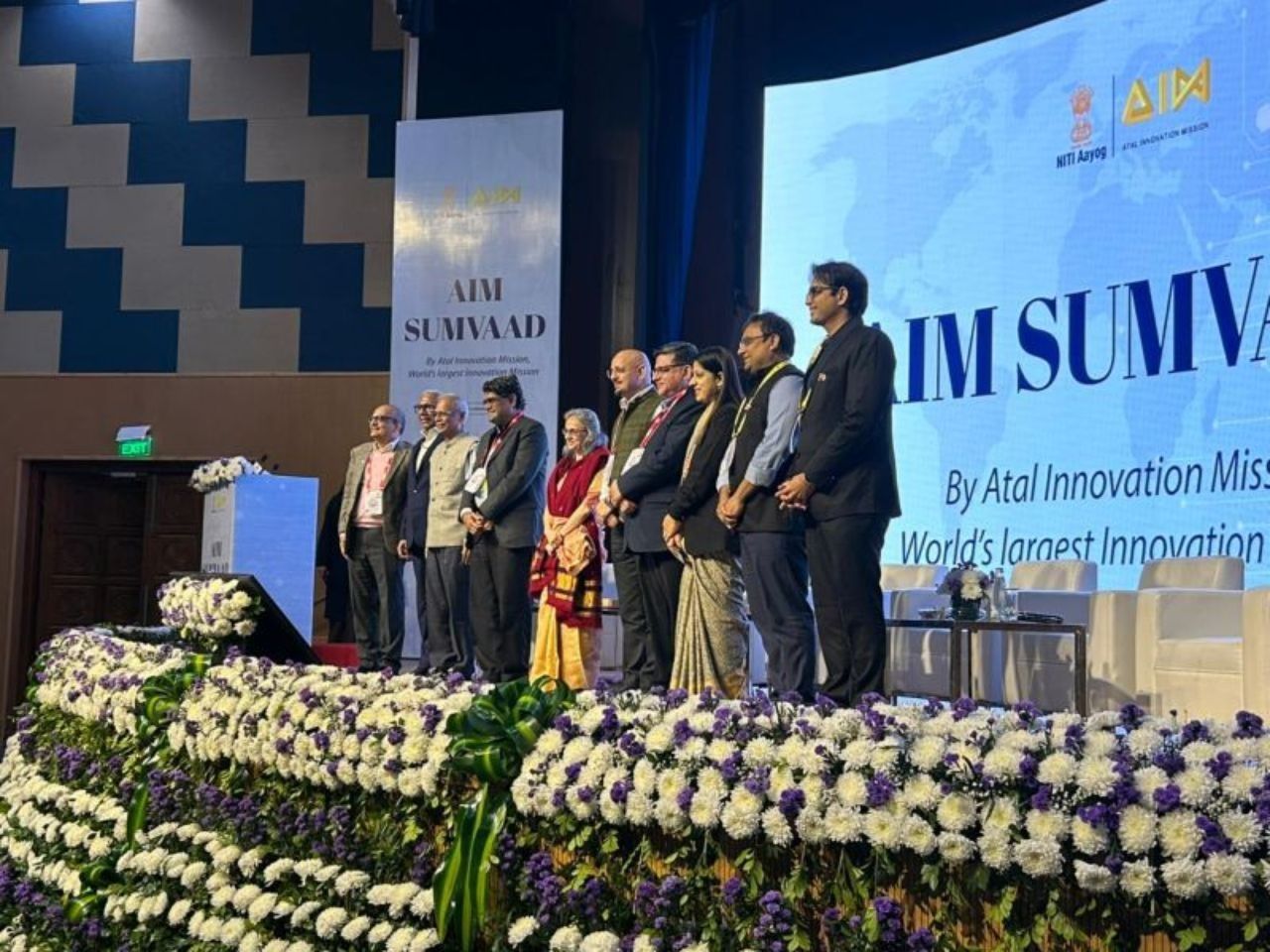
India’s startup story is no longer just about unicorn valuations or headline-grabbing funding rounds. It is increasingly about the quiet but powerful institutions that shape ideas at their earliest stages—incubators, community innovation centres, mentors, policymakers and investors working together to turn raw innovation into scalable impact. That larger, more structural story came into sharp focus at AIM SUMVAAD, the flagship annual incubator conclave organised by the Atal Innovation Mission under NITI Aayog.
Held as a national gathering of India’s incubation ecosystem, AIM SUMVAAD brought together representatives from over 100 Atal Incubation Centres and Atal Community Innovation Centres, alongside senior policymakers, industry leaders, investors, founders, CSR heads, mentors and ecosystem enablers from across the country. The conclave marked a moment of reflection—and ambition—for a startup ecosystem that has moved from promise to scale, and now seeks depth, quality and long-term impact.
Atal Innovation Mission SUMVAAD
AIM SUMVAAD was not just a conference; it functioned as a working platform for the future of India’s incubation and startup agenda. The day witnessed multiple milestones: the celebration of over 100 AIM-supported incubators nationwide, the launch of the Youth Co:Lab National Innovation Challenge 2026, the announcement of indicators for the National Incubator Assessment Framework, and the National Incubation Awards recognising high-impact incubators across regions and sectors.
Together, these announcements reflected a clear shift—from simply expanding the number of incubators to strengthening their quality, accountability and outcomes.
Building transparency through the National Incubator Assessment Framework
One of the most consequential announcements came from Union Minister of State (Independent Charge) for Science and Technology Jitendra Singh, who unveiled the indicators for the National Incubator Assessment Framework. The framework is a joint initiative of AIM, Department of Biotechnology, Department of Science and Technology and Department for Promotion of Industry and Internal Trade, and will now be opened up for nationwide consultations before finalisation.
The objective is clear: create a common, transparent and data-driven way to benchmark incubators across India. Once operational, the framework is expected to evolve into a centralised digital national repository—enabling peer learning, healthy competition and evidence-based decision-making across the ecosystem.
In his address, the Minister placed AIM’s journey in a broader national context. What began as an early effort to nurture a few hundred startups has today expanded into an ecosystem of over two lakh startups nationwide, generating more than 21,000 jobs and reshaping how young Indians think about livelihoods. Innovation and entrepreneurship, he noted, are no longer alternatives to government employment—they are becoming aspirations in their own right.
He also drew attention to the alignment between the Union Budget 2026–27 and India’s innovation priorities, particularly in bio-manufacturing, biotechnology, bio-refineries and bio-pharma—sectors where startups, research institutions and incubators are increasingly intersecting.
Startups and productivity at the heart of Viksit Bharat 2047
Linking entrepreneurship directly to India’s long-term development goals, Suman Bery, Vice Chairperson of NITI Aayog, emphasised that startup-led innovation will be central to achieving the vision of Viksit Bharat by 2047.
His message was grounded in economics as much as aspiration: India’s growth trajectory depends on sustained productivity gains, and startups—especially those commercialising new technologies and business models—are key drivers of that productivity. Incubators, in this sense, are not peripheral support structures but essential economic infrastructure.
Deep-tech incubators as strategic national assets
The focus on depth over breadth was echoed by Ajay Kumar Sood, Principal Scientific Adviser to the Government of India. He underlined the urgent need to expand India’s deep-tech startup base, arguing that a developed India must see at least 30% of its startups operating in deep-technology domains.
Incubators, he noted, are strategic national assets in this journey—spaces where science, engineering and entrepreneurship converge, and where long-gestation innovations can be nurtured with patience and capital.
From schools to communities to the world: AIM’s multi-layered model
Offering a systems-level view, B V R Subrahmanyam, CEO of NITI Aayog, described AIM as a rare national mission that connects innovation across every layer of society. From Atal Tinkering Labs in schools, to AICs in colleges, ACICs in underserved communities, and international innovation networks, AIM’s footprint spans the entire innovation lifecycle.
With nearly 10% of India’s incubators operating under the AIM umbrella, the mission is now focused on driving market impact—helping startups move beyond ideation into scale, revenue and global relevance.
From innovation to scale: voices from founders, investors and policymakers
The conclave also turned the spotlight on the practical challenges of scaling innovation. In the Trailblazer session, Abhishek Singh, Additional Secretary at the Ministry of Electronics and Information Technology, spoke about how artificial intelligence could power India’s next phase of growth.
Founders and investors added grounded perspectives from the trenches. Atomberg founder Manoj Meena, BioPrime founder Dr Renuka Diwan, and Speciale Invest co-founder Vishesh Rajaram discussed what it takes for startups to cross the chasm from innovation to commercial scale—highlighting patient capital, strong technology transfer, and founder-incubator alignment as decisive factors.
Incubators as technology transfer engines
A recurring theme across sessions was the evolving role of incubators as Technology Transfer Organisations (TTOs). Beyond mentoring and workspace, incubators are increasingly expected to bridge research institutions and markets—managing intellectual property, enabling commercialisation and supporting long-term scaling.
Discussions also explored how language diversity and cultural context shape innovation outcomes, the need for inclusive talent pipelines, and the ethical integration of AI. Venture capital decision-making, particularly the importance of long-term capital for deep-tech ventures, emerged as another critical pillar.
Aligning policy intent with outcomes
Summing up the spirit of the conclave, Deepak Bagla, Mission Director of Atal Innovation Mission, described AIM SUMVAAD as a platform designed to align policy intent with measurable outcomes.
The conclave, he said, aims to strengthen institutional capacity and ecosystem partnerships, creating a high-quality, outcomes-driven incubation framework that advances the Prime Minister’s vision of Viksit Bharat.
That emphasis on collaboration was reinforced by UNDP India Resident Representative Angela Lusigi, who highlighted the role of multi-stakeholder platforms in building inclusive and sustainable innovation ecosystems.
Incubators as the backbone of India’s innovation economy
Today, AIM-supported incubators have collectively incubated over 5,000 startups and enabled the creation of more than 50,000 jobs—quietly positioning themselves as the backbone of India’s innovation economy.
AIM SUMVAAD reaffirmed that India’s startup future will not be built by founders alone, nor by policy in isolation, but by strong institutions that connect ideas to markets at scale. As India looks ahead to 2047, the conclave underscored a simple truth: the strength of the country’s incubation ecosystem may well determine the depth and durability of its innovation-led growth.